Telugu Wedding Rituals: 16 Ceremonies & the Complete 2026 Guide
Every Telugu wedding ritual in order, from Pellichoopulu to Nagavalli — plus the three-day timeline, how the muhurtham is chosen, what it costs in 2026, and what belongs on your invitation.

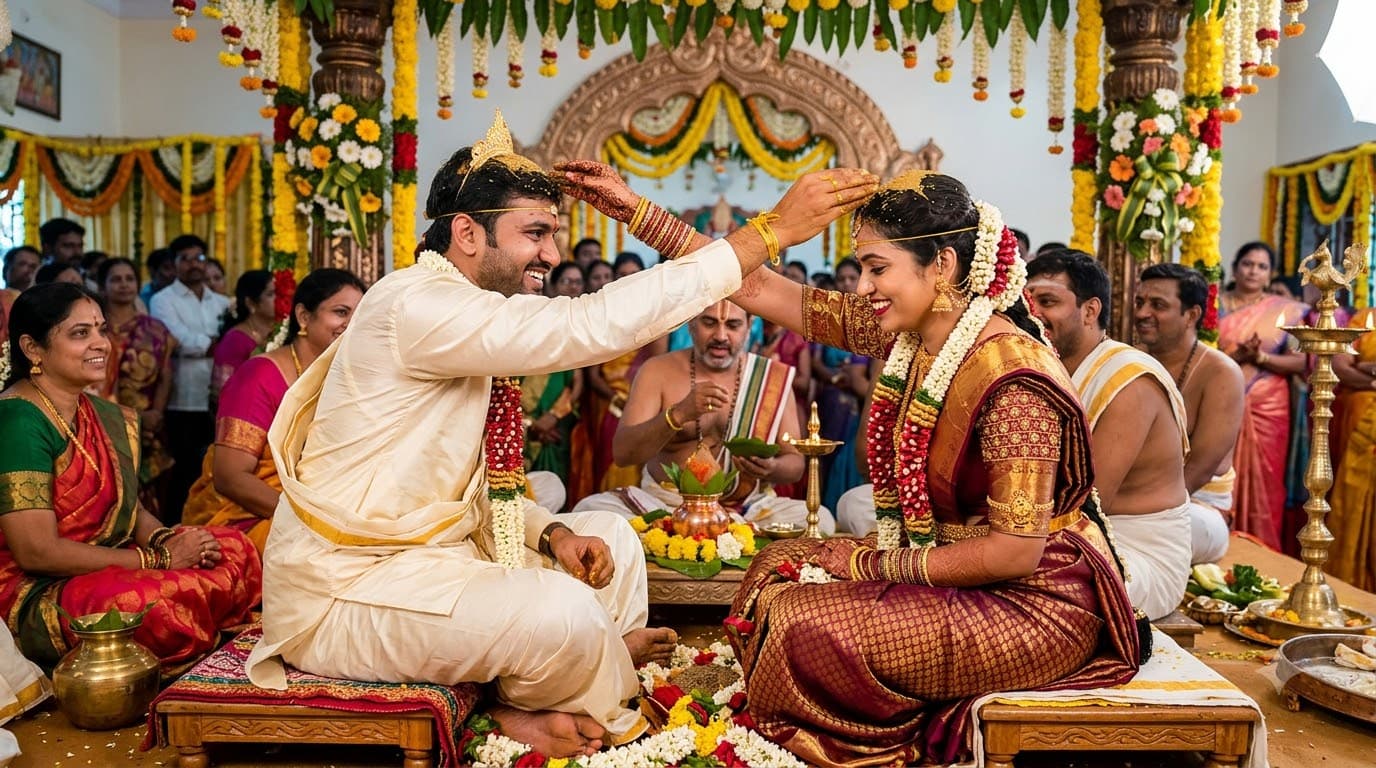
Key Takeaway: Telugu wedding rituals follow a tight, purohit-led sequence built around one fixed point — the muhurtham, the exact minute at which the couple place jeelakarra bellam on each other’s heads. Everything else in a Telugu wedding, from the pre-dawn Mangala Snaanam to the Appagintalu farewell, is scheduled backwards and forwards from that minute. This guide walks through all 16 ceremonies in order, the three-day timeline, how muhurtham dates are chosen, what the wedding actually costs in 2026, and exactly what belongs on your invitation.
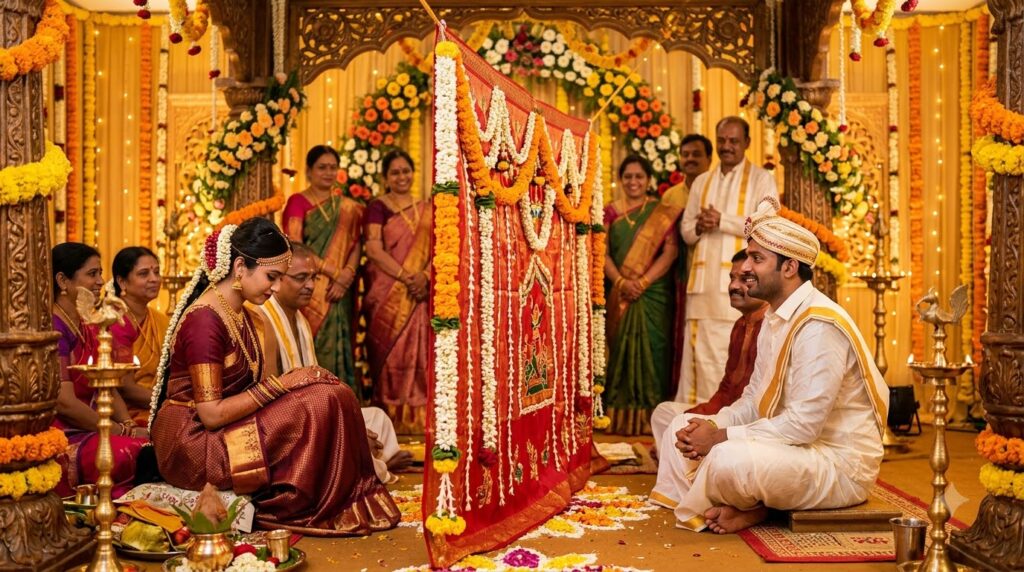
Table of Contents
- What Makes a Telugu Wedding Different
- Pre-Wedding Rituals (7 Ceremonies)
- Wedding Day Rituals (7 Ceremonies)
- Post-Wedding Rituals (2 Ceremonies)
- The Three-Day Telugu Wedding Timeline
- Choosing the Muhurtham: Dates Telugu Families Avoid
- Attire, Jewellery, and the Basikam
- The Feast: Andhra and Telangana on a Banana Leaf
- What a Telugu Wedding Costs in 2026
- Telugu Wedding Invitations: What Belongs on the Card
- Planning a Telugu Wedding from Abroad
- Telugu Wedding Glossary
- Planning Your Telugu Wedding with MyShaadhi Link
- Frequently Asked Questions
What Makes a Telugu Wedding Different
FIVE THINGS THAT SURPRISE FIRST-TIME GUESTS
If your only reference point is a North Indian wedding, a Telugu wedding will feel structurally different from the first hour. Telugu wedding rituals — practised across Andhra Pradesh, Telangana, and Telugu families settled around the world — are shaped by the Vedic ceremony rather than by the evening-party format, and five differences explain almost everything a newcomer notices. The Telugu Hindu wedding tradition has kept this structure remarkably intact even as the celebration around it has modernised.
1. The wedding happens in the morning — sometimes before sunrise
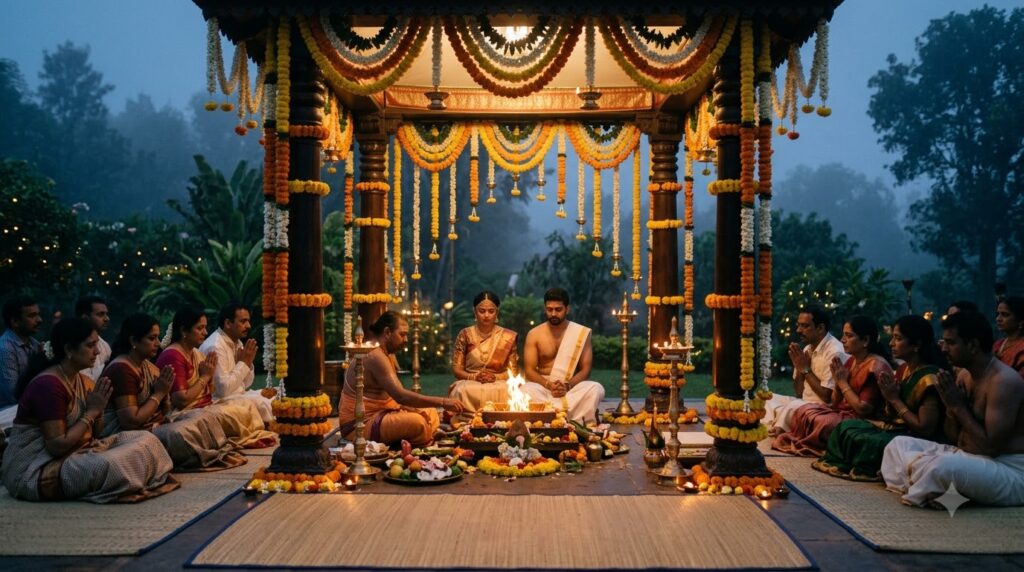
Telugu muhurthams are frequently set between 4am and 11am, and pre-dawn slots such as 5:12am are entirely normal. The time is not chosen for convenience; it is calculated from the panchangam and it is not negotiable. Guests turn up in the dark, the ceremony finishes by mid-morning, and lunch is served on a banana leaf by noon.
2. The marriage is sealed with cumin and jaggery, not with the ring
The defining moment of a Telugu wedding is Jeelakarra Bellam (జీలకర్ర బెల్లం) — a paste of cumin seed and jaggery that the bride and groom press onto each other’s heads at the exact muhurtham minute. For most Telugu families this, rather than the mangalsutra or the saptapadi, is the instant the marriage takes effect.
3. A curtain separates the couple until that moment
A cloth screen, the tera or antarpat, is held between bride and groom while the purohit chants. It drops only at the muhurtham, so the couple’s first look at each other as a married pair happens in front of everybody. Photographers plan the entire morning around this drop.
4. There is traditionally no baraat
The groom’s procession as North India knows it is not part of classical Telugu wedding rituals. What you get instead is Kashi Yatra — the groom theatrically threatening to abandon marriage for a life of study in Varanasi, and the bride’s brother talking him out of it. Many urban families now add a baraat-style entry anyway; it sits alongside the tradition rather than inside it.
5. The bride’s family are hosts, not guests
The ceremony takes place at the bride’s side, and the sequence is built around kanyadaanam — the formal giving of the daughter — and closes with appagintalu, the farewell that is, without exception, the most emotional twenty minutes of the day.
Pro tip: Ritual order varies by community, by region, and by family — Andhra, Telangana, Rayalaseema, Vaidiki, Niyogi, Kamma, Reddy, Kapu, and Telugu Brahmin households all differ in detail. Treat this guide as the shared spine and let your purohit’s sequence be the final authority.
Pre-Wedding Rituals (7 Ceremonies)
FROM FIRST MEETING TO THE MANDAP
The pre-wedding Telugu wedding rituals run from the first meeting of the two families to the morning of the ceremony itself, and several of them happen at both homes simultaneously. These are the seven you will be asked to plan for.
1. Pellichoopulu (పెళ్లిచూపులు)
The formal first meeting of the two families. The couple are introduced, elders talk, horoscopes are compared, and — in the traditional version — the bride serves sweets and snacks to the visiting family. In modern Telugu weddings, particularly where the couple already know each other, Pellichoopulu survives as a ceremonial gathering rather than an assessment.
2. Nischitartham (నిశ్చితార్థం)
The engagement, and the first genuinely binding step. A Ganesh puja opens the ceremony, the families exchange rings and gifts, the bride is given a saree and jewellery by the groom’s family, and the purohit reads out the lagna patrika — the written agreement naming both families and, crucially, fixing the wedding muhurtham. Once Nischitartham is done, the date exists and everything else in your planning hangs off it.
3. Pellikuthuru and Pellikoduku (పెళ్లికూతురు / పెళ్లికొడుకు)
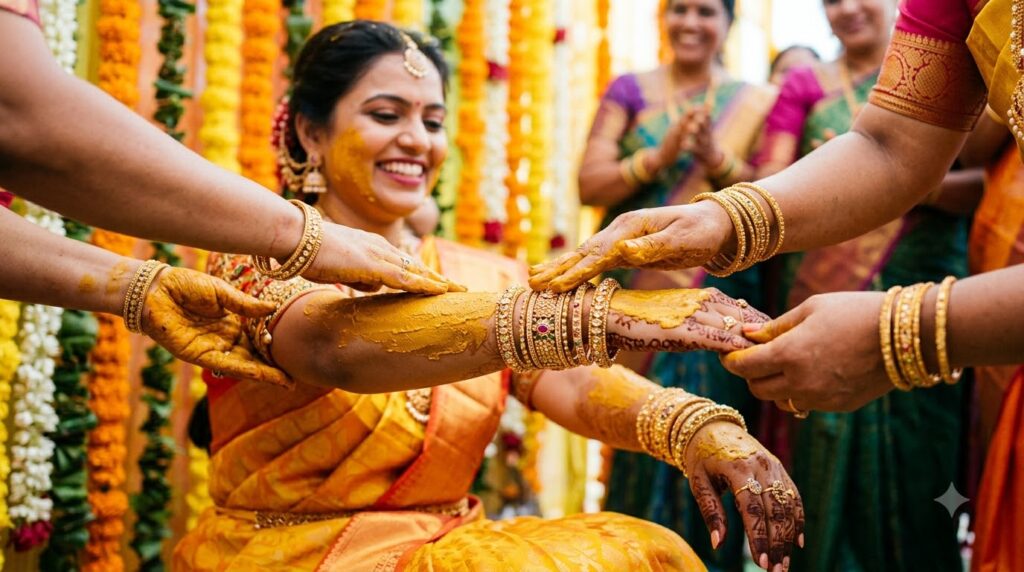
The Telugu equivalent of the haldi, performed separately at each home. Married women apply turmeric paste and oil to the bride (Pellikuthuru) and the groom (Pellikoduku), bathe them, and dress them in new clothes. From this point they are ceremonially “the bride” and “the groom” and traditionally do not leave the house until the wedding. Expect turmeric, laughter, and the loudest music of the entire event.
4. Mangala Snaanam (మంగళ స్నానం)
The auspicious bath, taken by bride and groom at their own homes in the small hours of the wedding day to purify body and mind before entering the mandap. If your muhurtham is at 5am, Mangala Snaanam is happening at 3am — worth knowing before you book the makeup artist.
5. Snathakam (స్నాతకం)
Performed a few hours before the ceremony, Snathakam marks the groom’s graduation from brahmacharya — the student stage of life — into grihastha, the householder stage. He is dressed in a silk dhoti and a silver thread is placed across his shoulder. It is short, quiet, and the reason the groom appears at the mandap already in ritual dress.
6. Kashi Yatra (కాశీ యాత్ర)
The most enjoyable ritual to watch. Carrying an umbrella, a walking stick, and a fan, the groom announces that he is renouncing worldly life and setting off for Kashi to study. The bride’s brother intercepts him at the gate and persuades him — with the promise of his sister’s hand and the responsibilities of family life — to turn back. He relents, and is escorted to the mandap. Ten minutes of theatre with a serious point: marriage as a conscious choice over renunciation.
7. Gauri and Ganesh Puja
Before the couple are brought together, the bride worships Gauri for a long and happy married life while the groom performs Ganesh puja to clear obstacles from the ceremony. The sacred fire is lit at this stage and the mandap is formally consecrated.
Wedding Day Rituals (7 Ceremonies)
THE CEREMONY ITSELF, IN ORDER
These are the Telugu wedding rituals performed inside the mandap, in the order your purohit will run them. The whole sequence usually takes three to four hours, with the muhurtham sitting roughly in the middle.
8. Madhuparkam (మధుపర్కం)
Bride and groom change into simple handwoven cotton — a white or cream saree with a red border for her, a matching dhoti for him — and are offered a mixture of honey, ghee, curd, and sugar. The plain cotton is deliberate: purity and simplicity at the ritual core, before the silk and gold come back on for the reception.
9. Kanyadaanam (కన్యాదానం)
The bride’s father places her hand in the groom’s and formally gives her into his care, with the groom pledging to support her in dharma, artha, and kama. In many Telugu families the bride is carried to the mandap in a bamboo basket by her maternal uncles for this ritual — a detail visitors from other communities almost always remember.
10. Jeelakarra Bellam (జీలకర్ర బెల్లం)
The heart of every Telugu wedding. With the curtain still between them, bride and groom each hold a paste of cumin seed (jeelakarra) and jaggery (bellam) and, on the purohit’s signal, press it onto each other’s heads. The pairing is the point: cumin is bitter, jaggery is sweet, and the couple accept both together and inseparably. The curtain drops, they see each other, and by tradition they are married.
This is the one item in your schedule that cannot move. Every other function of the day is arranged around it.
11. Mangalsutra Dharana (మంగళసూత్రం)
The groom ties the mangalsutra around the bride’s neck with three knots, to the sound of nadaswaram and dolu played loudly enough to drown out any inauspicious noise. The Telugu mangalsutra is distinctive: it carries two gold discs (pustelu) on a turmeric-dyed thread, one contributed by each family, symbolising the union of both households. The first two knots are tied by the groom and the third, in many families, by his sister.
12. Talambralu (తలంబ్రాలు)
Rice mixed with turmeric, and sometimes pearls or saffron, is poured by the couple over each other’s heads — three formal rounds, followed by a free-for-all that both families cheerfully escalate. Talambralu is the most photographed ritual of a Telugu wedding and the one that turns a solemn morning into a celebration. Rice symbolises prosperity and fertility; the competition over who pours more is entirely traditional.
13. Saptapadi (సప్తపది)
Seven steps around the agni, each with its own vow — nourishment, strength, prosperity, happiness, progeny, health, and lifelong friendship. Of all the Telugu wedding rituals this is the one that carries legal weight as well as spiritual weight: under Section 7 of the Hindu Marriage Act, 1955, where saptapadi forms part of the ceremony the marriage becomes complete and binding when the seventh step is taken.
14. Sthalipakam and Arundhati Nakshatram (స్థాలీపాకం)
The groom slides silver toe rings (mettelu) onto the bride’s second toes and places black beads in her mangalsutra to ward off ill fortune. He then shows her the star Arundhati, the wife of sage Vasishtha, held up as the model of devotion and constancy. At a pre-dawn muhurtham the star may genuinely be visible; at a later one, the purohit points to where it would be.
Post-Wedding Rituals (2 Ceremonies)
LEAVING ONE HOME, ENTERING ANOTHER
The last two Telugu wedding rituals happen away from the mandap, and they are the ones families remember longest.
15. Appagintalu (అప్పగింతలు)
The bride’s family formally hand her over to the groom’s family, asking them to care for her as their own. She throws a handful of rice back over her shoulder as she leaves — a gesture of gratitude and of repaying what she has taken from her parents’ home. There is no version of this ritual that is not devastating, and every Telugu wedding photographer will tell you it produces the best photographs of the day.
16. Grihapravesham and Nagavalli (గృహప్రవేశం / నాగవల్లి)
The bride is welcomed into her new home, traditionally stepping over a pot of rice with her right foot so that prosperity enters with her, and is received with aarti at the threshold. Nagavalli, held the following day, is the closing puja and celebration — in most modern Telugu weddings this is merged with the reception, where the couple finally appear in full silk and jewellery for the photographs everybody was waiting for.
The Three-Day Telugu Wedding Timeline
FUNCTION BY FUNCTION
Most Telugu weddings now run across three days, with a mehendi and sangeet added ahead of the traditional core. The table below maps all sixteen Telugu wedding rituals onto a real schedule, assuming a muhurtham at 6:00am on Day 2 — which is where most of the planning difficulty comes from.
| When | Function | Who attends |
|---|---|---|
| Day 1, evening | Mehendi and Sangeet | Close family and friends, both sides |
| Day 1, late evening | Pellikuthuru / Pellikoduku | Family only, at each home separately |
| Day 2, 3:00–4:00am | Mangala Snaanam | Immediate family |
| Day 2, 4:30am | Snathakam and Kashi Yatra | Groom’s party arrives at venue |
| Day 2, 5:00am | Gauri and Ganesh Puja, Madhuparkam | Guests seated |
| Day 2, 5:40am | Kanyadaanam | Full gathering |
| Day 2, 6:00am | Jeelakarra Bellam — the muhurtham | Everyone, on time |
| Day 2, 6:10am | Mangalsutra Dharana and Talambralu | Full gathering |
| Day 2, 7:00am | Saptapadi, Sthalipakam, Arundhati | Full gathering |
| Day 2, 9:00am | Wedding breakfast, then lunch on banana leaf | All guests |
| Day 2, afternoon | Appagintalu | Both families |
| Day 2, evening | Grihapravesham | Groom’s family |
| Day 3, evening | Nagavalli and reception | Extended circle, colleagues, friends |
The scheduling problem this creates is specific to Telugu weddings: your guests need to be seated before 6:00am on a working weekday if that is when the muhurtham falls. A card that says “6:00am” and nothing else is not enough — guests need the arrival time, the venue map, and a reminder the night before. This is the single most common reason Telugu families move their invitations online, and it is worth reading how WhatsApp wedding invitations handle exactly this kind of last-mile reminder.
Choosing the Muhurtham: Dates Telugu Families Avoid
THE CALENDAR RULES NOBODY EXPLAINS TO YOU
The muhurtham is calculated by a purohit from the couple’s birth stars and the Telugu panchangam. You do not pick it from a list of preferred weekends — you receive it, and then you build the wedding around it. Every one of the Telugu wedding rituals on the day is scheduled forwards or backwards from that minute, so understanding a few of the constraints will save you a great deal of confusion when a date you liked is rejected.
Shunya masam — the blank months
Three Telugu months are traditionally treated as shunya masam, or void months, in which weddings are not conducted: Ashadam (roughly late June to July), Bhadrapadam (roughly September), and Pushyam (roughly late December to January). Between them these remove a substantial part of the year from consideration, which is why Telugu wedding season clusters heavily into a handful of months and why good venues and photographers in Hyderabad and Vijayawada are booked a year out.
What else the purohit is checking
- Nakshatram compatibility between the couple’s birth stars, and the rasi and gunas match from both horoscopes.
- Tithi and vaaram — the lunar day and weekday combination, some of which are excluded outright.
- Rahu kalam and Yamagandam — inauspicious windows within each day that the ceremony must not cross.
- Uttarayanam preference — the northward solar half-year, from mid-January, is generally favoured for weddings.
- Family exclusions — a bereavement in the past year, or another sibling’s wedding in the same year, can rule out dates for reasons that have nothing to do with the panchangam.
Pro tip: Ask the purohit for two or three viable muhurthams rather than one, and check venue and photographer availability against all of them before confirming at Nischitartham. Families who accept a single date first and go venue-hunting afterwards routinely end up an hour outside the city.
Attire, Jewellery, and the Basikam
WHAT THE COUPLE ACTUALLY WEARS
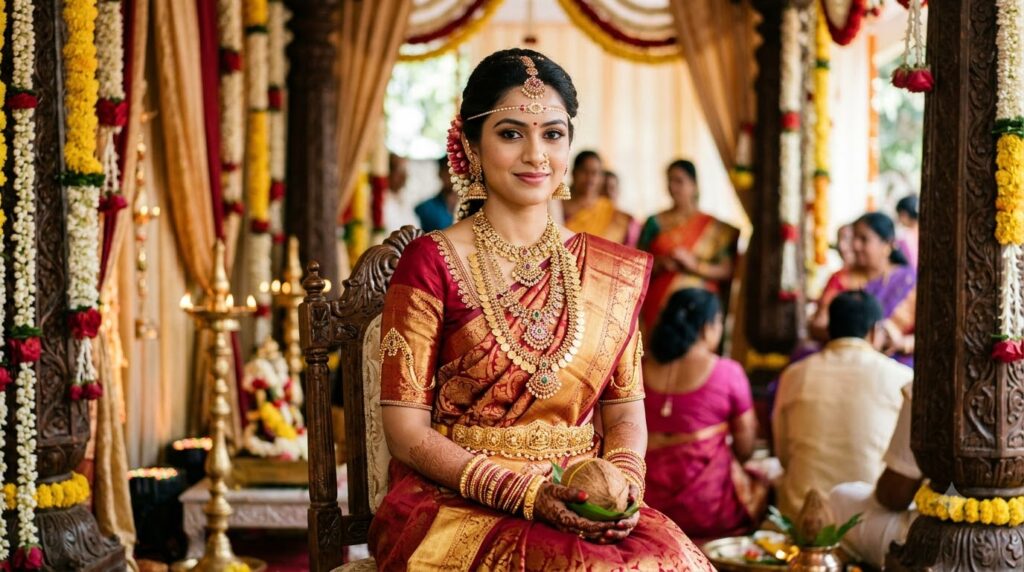
A Telugu bride changes at least twice on the wedding day, and the sequence matters. She arrives in silk, changes into plain cotton madhuparkam for the core Telugu wedding rituals, and returns to silk and gold for the reception.
The bride
- Saree: a handloom silk — Dharmavaram, Gadwal, Uppada, Venkatagiri, Pochampally, or a Kanjeevaram — most often in red, maroon, or green with a heavy gold zari border. Telangana brides frequently favour Gadwal and Narayanpet weaves.
- Jewellery: temple jewellery in the South Indian idiom — vaddanam (waist belt), kasula peru (coin necklace), nethi chutti (maang tikka), jhumkas, vanki (armlet), and bangles.
- Basikam: a decorated headband tied across the forehead — worn by both bride and groom, and one of the clearest visual markers of a Telugu wedding.
- Hair and flowers: a long plait dressed with jasmine, finished with a jada billalu ornament.
The groom
- Pancha and kanduva — a white or cream silk dhoti with a gold-bordered stole over the shoulder, worn for the ceremony itself.
- Basikam, tied across the forehead like the bride’s.
- Sherwani or bandhgala for the reception, where most grooms now move away from traditional dress.
Book blouse stitching and saree pre-pleating at least three weeks ahead of the muhurtham. Alterations during Telugu wedding season in Hyderabad are the single most common last-week emergency.
The Feast: Andhra and Telangana on a Banana Leaf
THE PART GUESTS TALK ABOUT AFTERWARDS
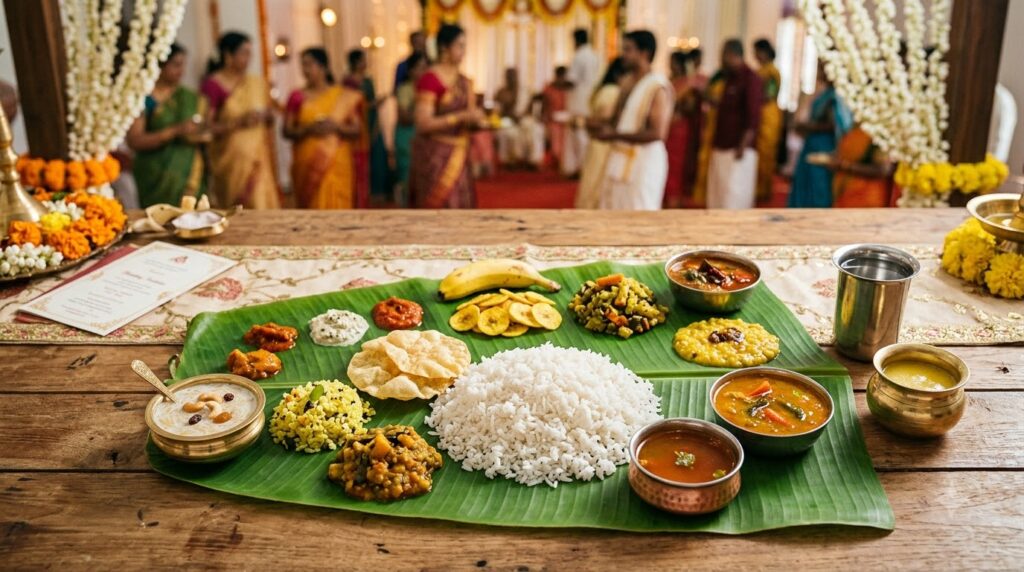
Once the Telugu wedding rituals in the mandap are finished, the feast begins. The food is served on a banana leaf in a fixed arrangement, with each item in its designated position and served in a set order. Guests are seated in rows and served continuously — the meal is not a buffet, and the serving staff will keep refilling until you fold the leaf.
| Course | Andhra style | Telangana style |
|---|---|---|
| Rice dishes | Pulihora, plain rice with ghee, pappu annam | Bagara annam, Hyderabadi biryani |
| Curries | Gutti vankaya, aloo fry, avakaya pickle | Mirchi ka salan, tamatar pappu |
| Fried items | Gaarelu (vada), punugulu, appadam | Gaarelu, sakinalu |
| Sweets | Bobbatlu, ariselu, poornam boorelu, laddu | Double ka meetha, qubani ka meetha, bobbatlu |
| To finish | Perugu annam with pickle, tamboolam | Perugu annam, tamboolam |
Two practical notes. First, a pre-dawn muhurtham means you are feeding guests tiffin — idli, vada, upma, pesarattu — before 9am and the full meal by noon, so your caterer needs the muhurtham time before quoting. Second, confirm your final headcount at least ten days ahead; Telugu wedding catering is quoted per plate and last-minute additions are where budgets quietly break.
What a Telugu Wedding Costs in 2026
INDICATIVE RANGES, NOT QUOTES
India hosts roughly 10 million weddings a year and the wedding industry is the country’s fourth-largest sector, with annual spending in the region of US$130 billion. Within that, a Telugu wedding is unusual in one respect: the Telugu wedding rituals themselves are comparatively inexpensive to perform, while catering and gold carry a disproportionate share of the total.
The ranges below reflect a 300–500 guest wedding in Hyderabad, Vijayawada, or Visakhapatnam. Treat them as a planning baseline for conversations with vendors, not as quotations — prices move sharply with season, city, and muhurtham timing.
| Category | Typical range (INR) | What drives the number |
|---|---|---|
| Kalyana mandapam / function hall | ₹1.5–8 lakh | City, season, number of days booked |
| Catering | ₹600–1,800 per plate | Menu, tiffin plus lunch, live counters |
| Decor and mandap | ₹1–6 lakh | Fresh flowers vs. artificial, stage scale |
| Photography and video | ₹1–5 lakh | Pre-dawn coverage, drone, cinematic edit |
| Bridal jewellery (gold) | Highly variable | Gold rate on the day; usually the largest single line |
| Sarees and outfits, both families | ₹1.5–6 lakh | Handloom silk vs. designer |
| Purohit, puja items, mangalsutra | ₹25,000–1 lakh | Number of rituals, pustelu design |
| Nadaswaram and dolu, melam | ₹15,000–60,000 | Ensemble size, hours |
| Printed invitations | ₹80–400 per card | Paper, foiling, box cards, courier |
| Digital invitation | A fraction of print | Replaces most of the print run entirely |
Invitations are the easiest place to recover budget without any guest noticing a compromise. A 400-card print run with courier can cost more than the nadaswaram ensemble, and cards posted to relatives in the US or Australia routinely arrive after those guests have already needed to book flights. Couples planning a wedding under 10 lakhs typically cut invitation spend by 60–70% by going digital and printing only a small batch for elders.
Telugu Wedding Invitations: What Belongs on the Card
GET THIS WRONG AND GUESTS MISS THE MUHURTHAM
A Telugu wedding invitation carries more information than most, because the ceremony structure demands it — guests need to know which of the Telugu wedding rituals they are being invited to, and when each one starts. Whether you send print, digital, or both, every card should include:
- The Ganesh invocation at the top — శ్రీ గణేశాయ నమః or an equivalent line, traditionally opening the card.
- Both sets of parents’ names, and often the grandparents’, with the village or family name. In Telugu families the invitation is issued by the elders, not the couple.
- The muhurtham to the exact minute — “Muhurtham: 5:42am” — plus the Telugu calendar reference (year name, masam, tithi, nakshatram).
- An arrival time separate from the muhurtham time. Guests who read only the muhurtham arrive as it is ending.
- The full function list — mehendi, sangeet, pellikuthuru, muhurtham, reception — each with its own date, time, and venue.
- Venue with a map link. Kalyana mandapams are often on the outskirts and hard to find at 5am.
- Telugu and English together, so elders and younger or non-Telugu guests read the same card.
This is a lot to fit on printed card stock, which is why so many Telugu families now pair a small print run with a digital wedding invitation that carries the full schedule, the map, and an RSVP. If you want to see how the format works end to end, our guide to digital wedding websites covers what to include and what to leave out. And if you are adding a mehendi to the front of your three days, the complete mehndi ceremony guide covers that function in detail.
If you want an invitation built for this exact ceremony structure, the South Indian wedding invitation template — a digital pelli patrika comes with temple gopuram artwork, dedicated muhurtham and nakshatra fields, Telugu script support, and per-event RSVP cards for everything from Pellikuthuru to the reception.
Planning a Telugu Wedding from Abroad
FOR TELUGU FAMILIES IN THE US, UK, AND AUSTRALIA
Telugu families are among the most widely dispersed of any Indian community, and a large share of Telugu weddings now involve a couple or a guest list spread across continents. The Telugu wedding rituals do not change when the family is abroad — the logistics around them change completely. Three problems recur, and all three are solvable with lead time.
The muhurtham lands in the middle of the night for half your guests
A 6:00am muhurtham in Hyderabad is 7:30pm the previous evening in New York and 4:30pm in London. If you are livestreaming for relatives who cannot travel — now standard for Telugu weddings — publish the muhurtham in their local time as well as IST. Guests should not have to do the arithmetic themselves, and several will get it wrong if they do.
Overseas guests need months, not weeks
India-based relatives are comfortable being invited three to four weeks out. Guests flying from abroad need the date four to six months ahead to book affordable flights, arrange leave, and — where they hold a foreign passport without an OCI card — apply for a visa. Send a save-the-date as soon as the muhurtham is fixed at Nischitartham, long before the formal invitation exists.
RSVPs scattered across WhatsApp are not a headcount
Telugu weddings are catered per plate across multiple functions, and guests attend different subsets — overseas relatives come for all three days while local colleagues appear only at the reception. Collecting a single yes or no gives you a number your caterer cannot use. What works is one link that every guest responds through, per-function responses, the ability for one person to confirm an entire household, and a live count you can check at any hour without asking anyone.
Telugu Wedding Glossary
TERMS YOU WILL HEAR ALL WEEKEND
If you are attending your first Telugu wedding, these are the words you will hear repeatedly across the Telugu wedding rituals — worth a quick read before you arrive.
| Term | Telugu | Meaning |
|---|---|---|
| Muhurtham | ముహూర్తం | The exact auspicious minute of the marriage |
| Jeelakarra bellam | జీలకర్ర బెల్లం | Cumin and jaggery paste applied at the muhurtham |
| Pustelu | పుస్తెలు | The two gold discs of the mangalsutra |
| Basikam | బాసికం | Forehead ornament worn by bride and groom |
| Mettelu | మెట్టెలు | Silver toe rings given during Sthalipakam |
| Talambralu | తలంబ్రాలు | Turmeric rice showered by the couple |
| Madhuparkam | మధుపర్కం | Plain cotton ritual attire |
| Muggu | ముగ్గు | Rice-flour floor art at the entrance |
| Kalyana mandapam | కళ్యాణ మండపం | The wedding hall |
| Purohit | పురోహితుడు | The priest who conducts the rituals |
| Tamboolam | తాంబూలం | Betel leaf, nut, and gift given to guests |
| Appagintalu | అప్పగింతలు | The bride’s formal farewell |
Planning Your Telugu Wedding with MyShaadhi Link
BUILT FOR MULTI-FUNCTION, MULTI-CITY WEDDINGS
The hard parts of a Telugu wedding are not the Telugu wedding rituals themselves — your purohit and your elders have those covered. The hard parts are getting several hundred guests to the right venue before a 5:42am muhurtham, tracking who is attending which of five functions, and keeping relatives in Hyderabad, Houston, and Melbourne looking at the same schedule. That is what MyShaadhi Link is built for.
- Every function on one invitation. Mehendi, sangeet, pellikuthuru, muhurtham, and reception — each with its own date, time, and venue, all on a single link.
- The muhurtham, unmissable. A live countdown to the exact minute, so nobody arrives as the curtain is dropping.
- Venue maps built in. One tap to directions for a kalyana mandapam on the city outskirts, at 4am, in the dark.
- Live RSVP tracking, per function. Real numbers for your caterer instead of a guess, updating as guests respond.
- Telugu and English on the same card. Multilingual invitations so elders read the card in their own language and nobody gets a second, different version.
- Shared over WhatsApp, opens anywhere. No app, no postage, no card arriving in Sydney three weeks late.
Browse the full range of invitation templates or see pricing to get started. Your muhurtham is fixed to the minute — your guest list should be just as precise.
Telugu wedding rituals have survived largely unchanged because they are built around one immovable point and a clear sequence. Everything modern that gets added — the sangeet, the livestream, the digital invitation — works best when it is arranged around that spine rather than against it. Fix the muhurtham first, tell your guests early and precisely, and the rest of the wedding falls into place.
Frequently Asked Questions
What are the main Telugu wedding rituals?
The main Telugu wedding rituals, in order, are Pellichoopulu, Nischitartham, Pellikuthuru and Pellikoduku, Mangala Snaanam, Snathakam, Kashi Yatra, Gauri and Ganesh puja, Madhuparkam, Kanyadaanam, Jeelakarra Bellam, Mangalsutra Dharana, Talambralu, Saptapadi, Sthalipakam, Appagintalu, and Grihapravesham with Nagavalli. Jeelakarra Bellam, performed at the exact muhurtham, is the moment most Telugu families regard as the marriage itself.
What is Jeelakarra Bellam and why is it important?
Jeelakarra Bellam is a paste of cumin seed and jaggery that the bride and groom press onto each other’s heads at the exact muhurtham minute, with a curtain still held between them. Cumin is bitter and jaggery is sweet, and applying them together represents accepting life’s bitterness and sweetness as one inseparable whole. It is the defining ritual of a Telugu wedding and the point at which the couple are considered married.
Why are Telugu weddings held so early in the morning?
The muhurtham is calculated by a purohit from the couple’s birth stars and the panchangam, and the auspicious window frequently falls between 4am and 11am. Pre-dawn slots are common and the timing is not adjusted for convenience. Guests should be seated well before the stated muhurtham, which is why Telugu invitations need an arrival time in addition to the muhurtham time.
How long does a Telugu wedding last?
The Telugu wedding rituals inside the mandap typically run three to four hours, from Snathakam to Sthalipakam. Most Telugu weddings now spread across three days: mehendi and sangeet on day one, the muhurtham and wedding rituals on day two, and Nagavalli with the reception on day three. Traditional celebrations ran to five days.
What is the difference between an Andhra and a Telangana wedding?
The ritual spine is the same across both states. The differences are in cuisine, weaves, and emphasis: Telangana weddings lean towards Hyderabadi biryani, bagara annam, and Gadwal or Narayanpet sarees, while Andhra weddings favour pulihora, gutti vankaya, bobbatlu, and Dharmavaram or Uppada silks. Individual community customs vary more than the state boundary does.
Which months are avoided for Telugu weddings?
Three Telugu months are traditionally treated as shunya masam, or void months, in which weddings are not conducted: Ashadam, Bhadrapadam, and Pushyam. Within permitted months the purohit also excludes specific tithis and avoids Rahu kalam and Yamagandam windows, and the northward solar half-year from mid-January is generally preferred.
What does a Telugu bride wear?
A Telugu bride wears a handloom silk saree — Dharmavaram, Gadwal, Uppada, Venkatagiri, or Kanjeevaram — usually in red, maroon, or green with a gold zari border, along with South Indian temple jewellery including a vaddanam waist belt and kasula peru necklace. For the ritual core she changes into plain cotton madhuparkam, and throughout she wears a basikam tied across her forehead, as does the groom.
What is the Telugu mangalsutra called and how is it different?
The Telugu mangalsutra carries two gold discs known as pustelu, one contributed by each family, strung on a turmeric-dyed thread. This two-disc design distinguishes it from most North Indian mangalsutras. The groom ties three knots, with the third often tied by his sister, and black beads are added later during Sthalipakam.
How much does a Telugu wedding cost?
Cost varies enormously with guest count, city, and season. For a 300 to 500 guest wedding in Hyderabad, Vijayawada, or Visakhapatnam, catering commonly runs ₹600 to ₹1,800 per plate, a function hall ₹1.5 to ₹8 lakh, decor ₹1 to ₹6 lakh, and photography ₹1 to ₹5 lakh. Gold jewellery is usually the single largest line item and moves with the gold rate. These are planning baselines for vendor conversations, not quotations.
When should Telugu wedding invitations be sent?
Send a save-the-date as soon as the muhurtham is fixed at Nischitartham. India-based guests can receive the formal invitation three to four weeks ahead, but guests travelling from abroad need four to six months to book flights, arrange leave, and apply for a visa if they hold a foreign passport without an OCI card. Every invitation should carry the muhurtham to the exact minute, a separate arrival time, the full function schedule, and a venue map link.
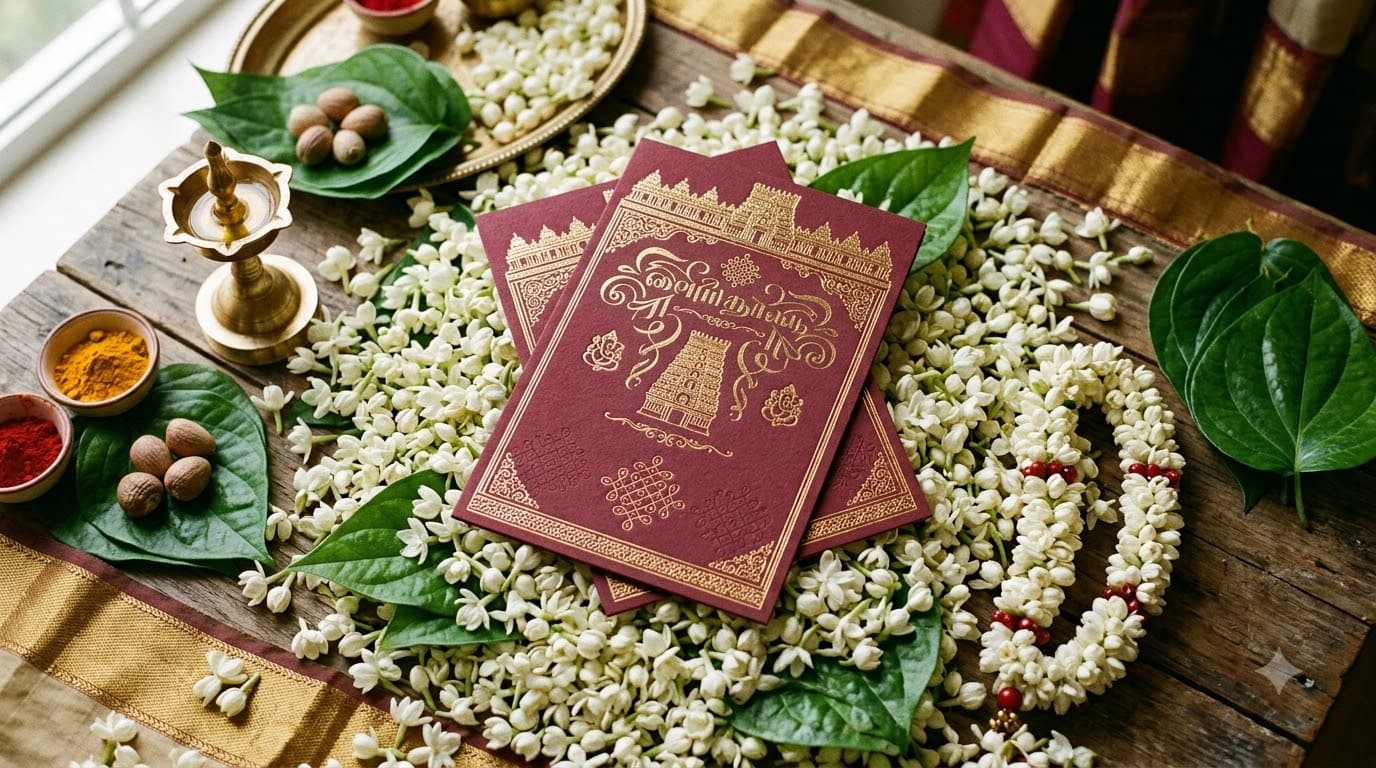 Tamil Weddings
Kovil Pathirikai: 7 Sacred Tips for a Beautiful Tamil Wedding
Key Takeaway: A kovil pathirikai wedding invitation is more than stationery; it is a sacred announcement that carries centuries of […]
Read article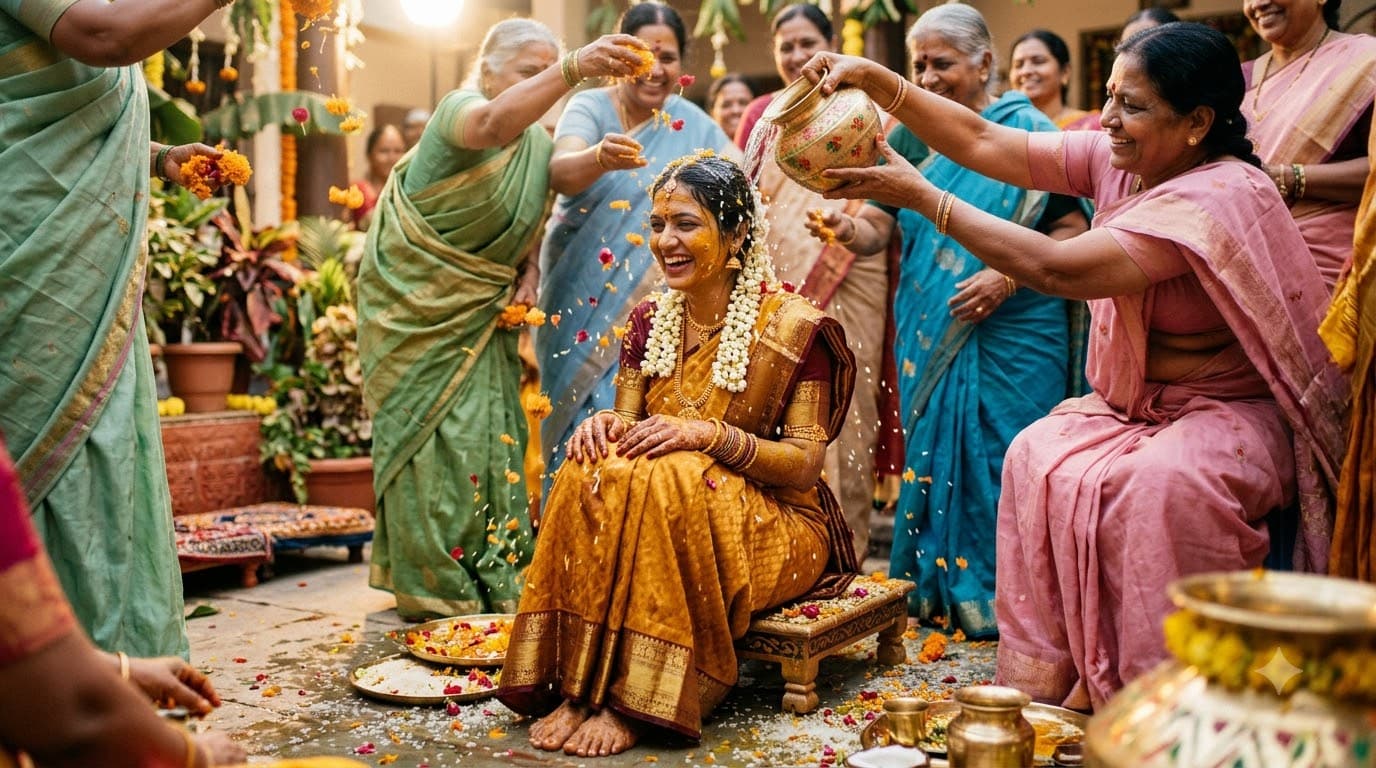 telugu-weddings
Pellikuthuru: 7 Sacred Rituals for a Beautiful Telugu Bride
Pellikuthuru is the sacred Telugu ritual where the bride is bathed in turmeric, anointed, and blessed by family before her wedding. Here’s the complete guide to its meaning, rituals, and planning.
Read article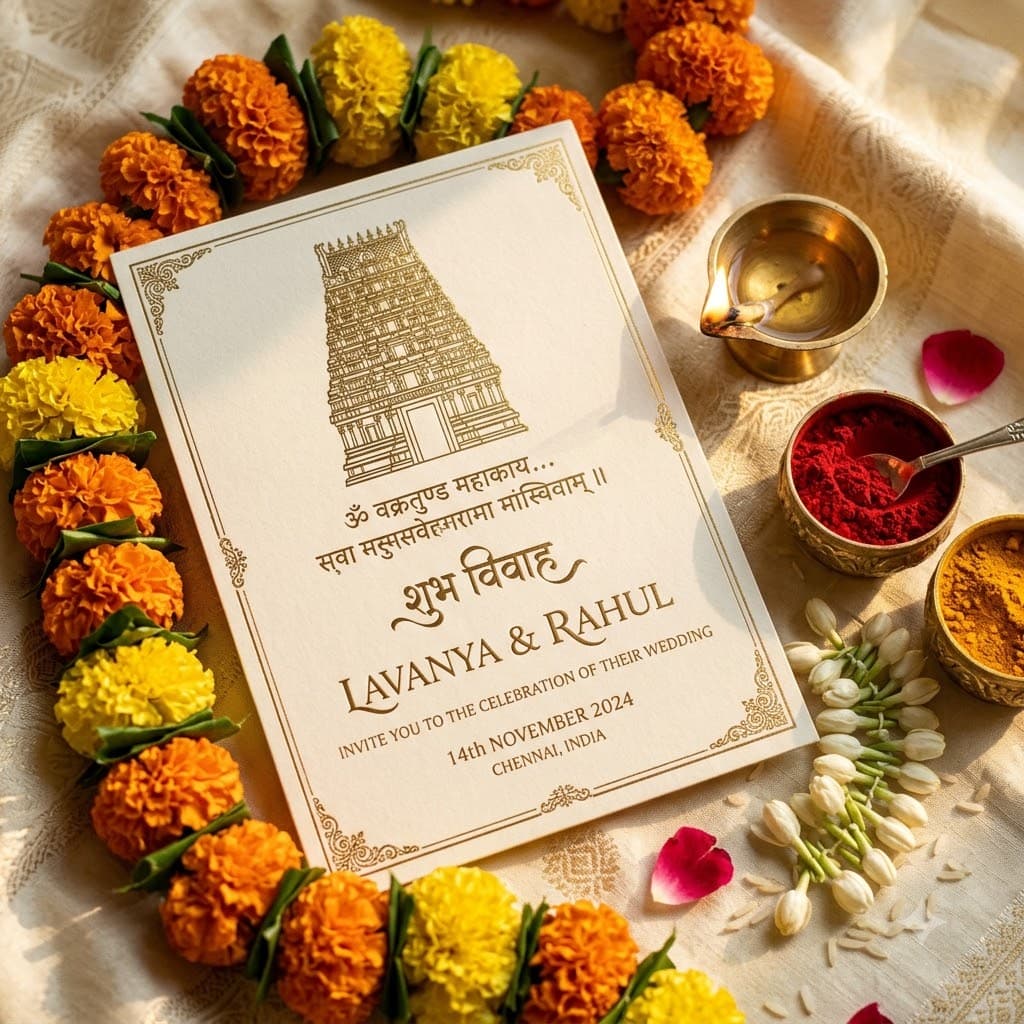 Invitation Ideas
Temple Wedding Invitation Wording: Best Guide (2026)
Key Takeaway: A temple wedding invitation is far more than a card announcing a date and venue. It is the […]
Read articleReady to create your wedding invitation?
Explore our handcrafted templates — designed for South Indian, Christian, and modern weddings. Share via WhatsApp in minutes.
Browse Templates