Pelli Patrika Matter in Telugu: Complete 5-Layer Wording Toolkit
Key Takeaway: Pelli patrika matter in Telugu follows a fixed five-layer structure — invocation, gothram and family lineage, the formal […]

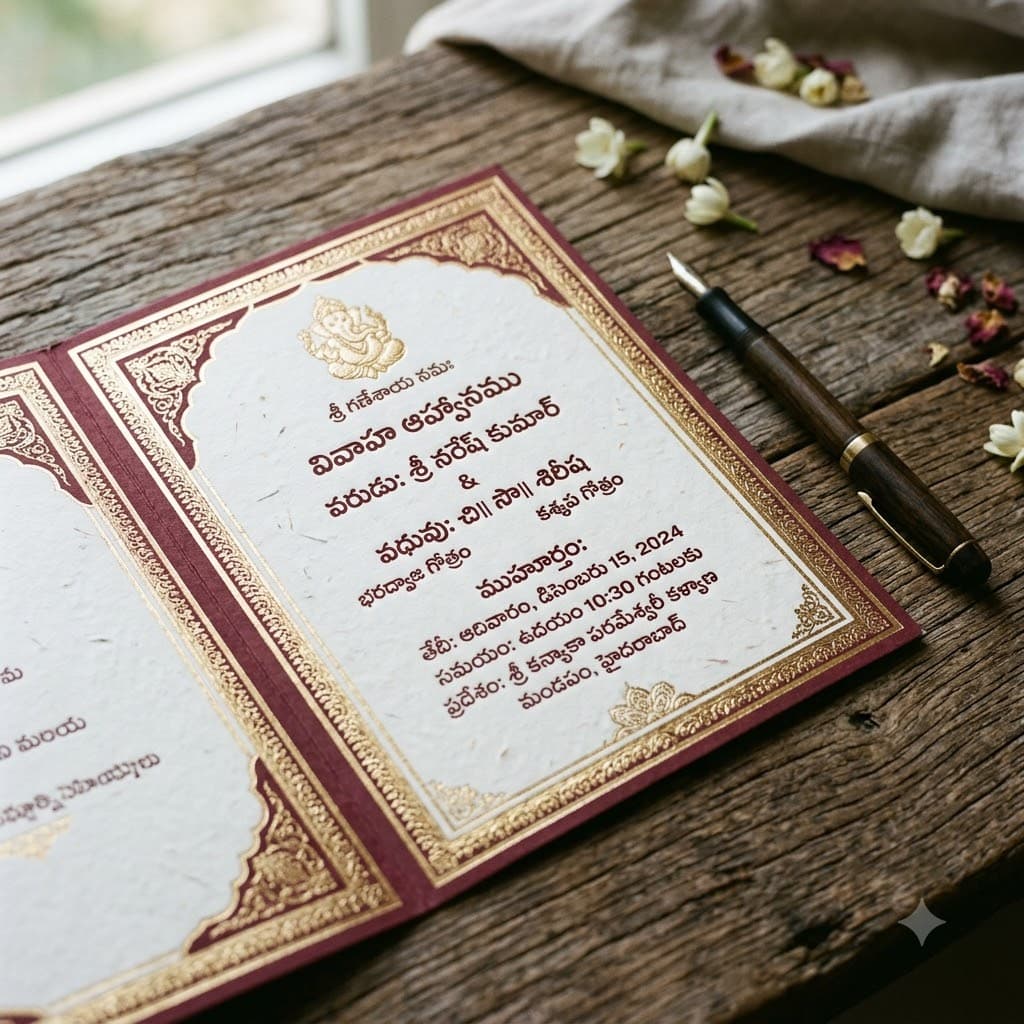
Key Takeaway: Pelli patrika matter in Telugu follows a fixed five-layer structure — invocation, gothram and family lineage, the formal invitation line, muhurtham details, and the elders’ blessing — and every section has its own conventional wording. This guide breaks that structure down layer by layer with copyable Telugu matter for each one, a bilingual sample card, and notes on adapting it for a digital invite. For the fuller etiquette, history, and modern format guide, see our complete Telugu wedding invitation wording guide.
Table of Contents
- What Is a Pelli Patrika
- The Five-Layer Structure of Pelli Patrika Matter in Telugu
- Layer 1: The Opening Invocation
- Layer 2: Gothram and Family Lineage
- Layer 3: The Formal Invitation Line
- Layer 4: Muhurtham and Event Details
- Layer 5: Blessing and Elders’ Names
- Sample Pelli Patrika Matter in Telugu for Every Wedding Event
- A Complete Bilingual Pelli Patrika Sample
- Adapting This Matter for a Digital Pelli Patrika
- Frequently Asked Questions
THE CARD, NOT THE CEREMONY
What Is a Pelli Patrika
A pelli patrika (పెళ్లి పత్రిక) is the formal Telugu wedding invitation — traditionally issued by the families rather than the couple, and built to carry far more structured information than a typical English-language card. Where most wedding invitations answer who, when, and where, a pelli patrika also carries the gothram of both families, the exact muhurtham to the minute, and a Ganapati invocation at the top, because the card itself is treated as part of the ritual, not just an announcement of it.
This guide is a section-by-section pelli patrika matter in Telugu toolkit — what goes in each layer of the card and sample matter you can adapt. If you want the broader picture first, including etiquette, modern bilingual formats, and full sample cards, our Telugu wedding invitation wording guide covers that ground; this piece goes deeper into the structure and the specific lines that make up each part of a pelli patrika.
READ THE CARD LIKE A PUROHIT WOULD
The Five-Layer Structure of Pelli Patrika Matter in Telugu
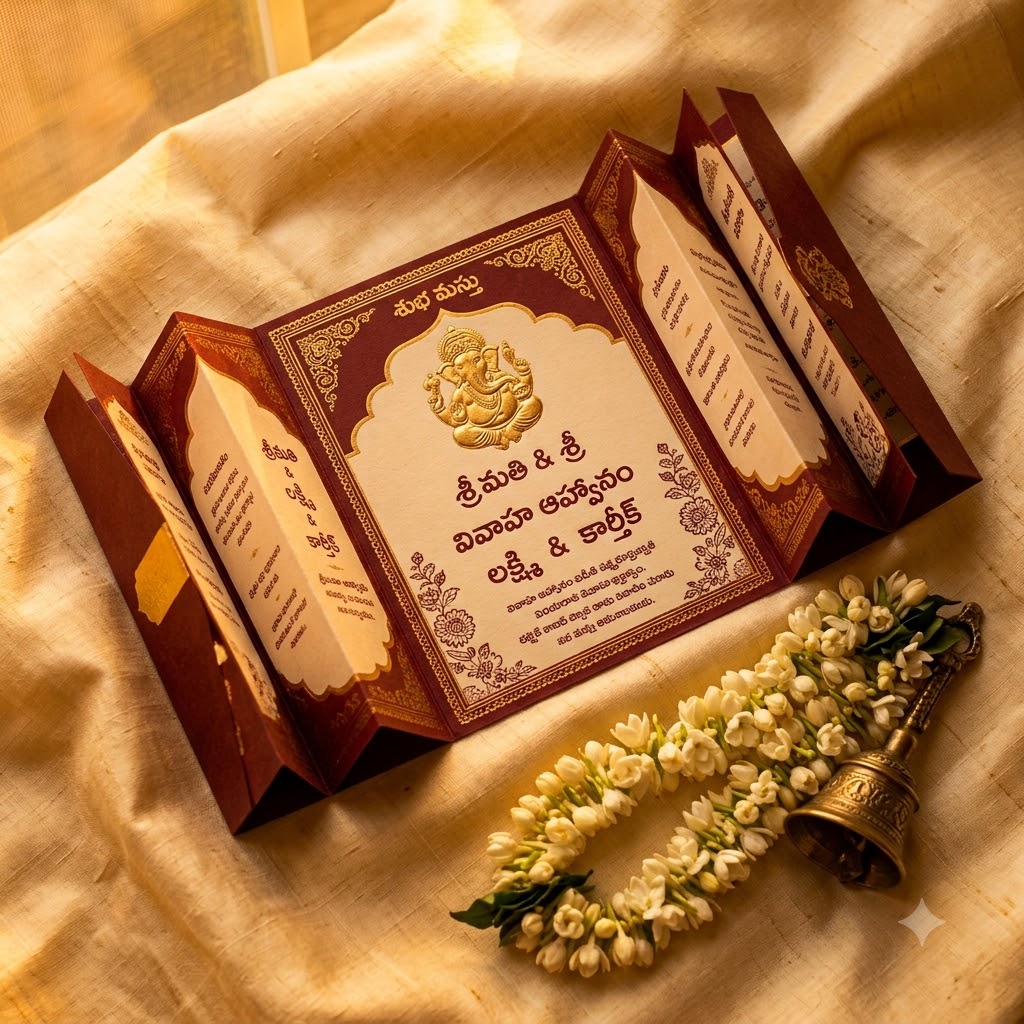
Almost every traditional pelli patrika, regardless of region or family tradition, is built from the same five layers stacked in the same order. The diagram below shows how they sit relative to each other, with the muhurtham layer highlighted, because it is the structural anchor everything else in the card is arranged around.
Not every family includes all five layers in full — shorter modern cards sometimes compress the gothram line or drop the invocation shloka to a single word. But knowing what each layer is doing makes it far easier to decide what to keep, shorten, or translate when you sit down to draft your own pelli patrika matter.
LAYER ONE
Layer 1: The Opening Invocation
Every traditional pelli patrika opens with a line invoking Lord Ganesha, seeking his blessing before any other text on the card. This is almost never skipped, even on otherwise modern, minimal cards.
శ్రీ గణేశాయ నమః
(Sri Ganeshaya Namah — Salutations to Lord Ganesha)
Some families extend this with a short additional sloka invoking the couple’s family deity, but the Ganapati line above is the minimum almost every pelli patrika carries, regardless of region or community.
LAYER TWO
Layer 2: Gothram and Family Lineage
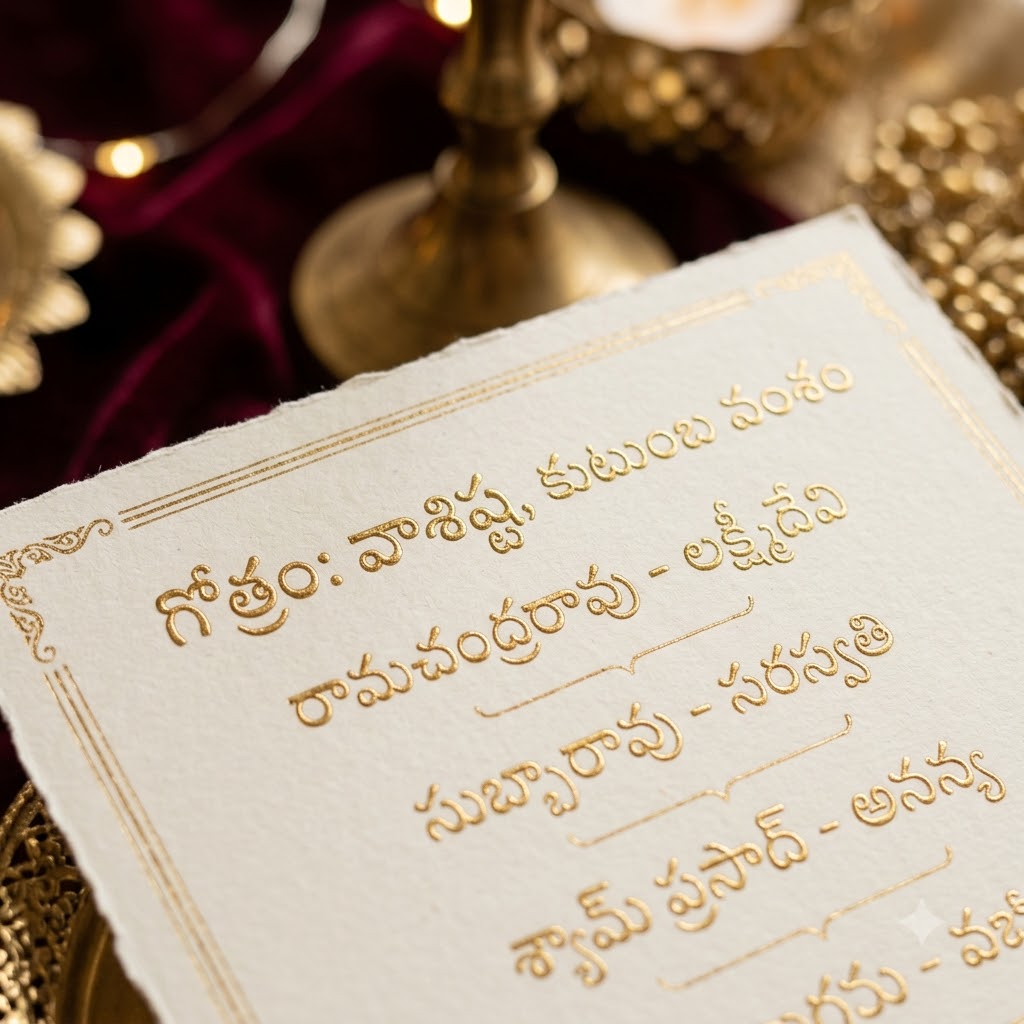
Immediately after the invocation, a pelli patrika names each family’s gothram — the patrilineal lineage traced back to a Vedic sage — alongside the parents’ and grandparents’ names. This layer exists in Telugu invitations in a way it rarely does in other regional wedding invitation traditions, and it is the line elders check first.
[Bride’s gothram] గోత్రీకులు, శ్రీ [తండ్రి పేరు] గారి కుమార్తె
చిరంజీవి [వధువు పేరు]
కి
[వరుడి గోత్రం] గోత్రీకులు, శ్రీ [తండ్రి పేరు] గారి కుమారుడు
చిరంజీవి [వరుడి పేరు]
The bracketed portions are exactly what your purohit will ask you for when the lagna patrika is drawn up at Nischitartham — gothram, father’s name, and the couple’s given names prefixed with Chiranjeevi for the groom and an equivalent honorific for the bride. Fill these in from your own family record rather than guessing, since an incorrect gothram on a printed card is difficult to correct once distributed.
LAYER THREE
Layer 3: The Formal Invitation Line
This is the line that actually extends the invitation, sitting between the family lineage and the muhurtham details. It is short by design, since the surrounding layers already carry the weight of who is marrying whom.
వివాహ మహోత్సవమునకు తమరిని ఆహ్వానించుచున్నాము
(We cordially invite you to the wedding celebration)
Modern cards often soften this into a warmer, more conversational English line placed alongside the Telugu — “You and your family are warmly invited to bless the couple” is a common pairing when the card is meant to be read by both English- and Telugu-first guests.
LAYER FOUR
Layer 4: Muhurtham and Event Details
The muhurtham layer is the one line every guest actually needs to act on, which is why it is set apart visually on most cards — larger type, a border, or a highlighted panel, as shown in the diagram above. It carries the exact time down to the minute, plus the Telugu calendar reference, since the muhurtham is fixed by the panchangam rather than by convenience.
వివాహ ముహూర్తం: ఉదయం [గంట] గంటలకు
[సంవత్సరం నామ] సంవత్సర, [మాసం] మాసం, [తిథి] తిథి, [నక్షత్రం] నక్షత్రంలో
(Wedding muhurtham: [time] — [year name] year, [month] month, [tithi], [nakshatram])
Print the arrival time as a separate line from the muhurtham time itself. A guest who reads only the muhurtham and times their arrival to it will walk in as the ceremony is ending, not starting.
LAYER FIVE
Layer 5: Blessing and Elders’ Names
The closing layer names the hosting elders — typically both sets of parents, sometimes grandparents — and asks for their blessing on behalf of the couple, rather than simply signing off with an RSVP line.
ఆశీర్వదించి రావలసినదిగా ప్రార్థన
(You are lovingly requested to attend and bless the couple)
[వధువు తండ్రి పేరు] & [వధువు తల్లి పేరు]
[వరుడు తండ్రి పేరు] & [వరుడు తల్లి పేరు]
Because the invitation is issued by the elders rather than the couple, this closing line — not a couple’s signature — is where the pelli patrika formally ends.
EVENT BY EVENT
Sample Pelli Patrika Matter in Telugu for Every Wedding Event
A three-day Telugu wedding rarely fits inside a single wording block, so most families print or design a separate matter line for each function. The table below gives the wording focus and typical placement for the events most often listed, alongside the Kashi Yatra sample this guide’s diagram is built around.
| Event | Telugu Reference | Wording Focus | Placement in Card |
|---|---|---|---|
| Mangala Snanam | మంగళ స్నానం | Ritual bath invocation for close family | Opening panel, before muhurtham |
| Sumangali Prarthana | సుమంగళి ప్రార్థన | Blessing sought from married women elders | Inner fold, family section |
| Kashi Yatra | కాశీ యాత్ర | Brief mention of the groom’s ceremonial procession, brought back by the bride’s brother | Inner fold, pre-ceremony section |
If your card covers more functions — mehendi, sangeet, or a reception — the same pattern applies: name the event, its Telugu reference if it has one, a one-line wording focus, and where it sits relative to the muhurtham panel.
ALL FIVE LAYERS TOGETHER
A Complete Bilingual Pelli Patrika Sample
Stacking all five layers together gives you a full working draft of pelli patrika matter in Telugu. This version pairs Telugu with an English line under each section, the format most families now use so elders and English-first guests read the same card.
శ్రీ గణేశాయ నమః
Sri Ganeshaya Namah
[వధువు గోత్రం] గోత్రీకులు, శ్రీ [వధువు తండ్రి పేరు] గారి కుమార్తె చిరంజీవి [వధువు పేరు]
కి
[వరుడి గోత్రం] గోత్రీకులు, శ్రీ [వరుడి తండ్రి పేరు] గారి కుమారుడు చిరంజీవి [వరుడి పేరు]
Daughter of [bride’s father], [bride’s gothram] gothram, to son of [groom’s father], [groom’s gothram] gothram
వివాహ మహోత్సవమునకు తమరిని ఆహ్వానించుచున్నాము
You and your family are warmly invited to the wedding celebration
వివాహ ముహూర్తం: [తేదీ], ఉదయం [గంట] గంటలకు
Wedding muhurtham: [date], [time]
ఆశీర్వదించి రావలసినదిగా ప్రార్థన
[వధువు తల్లిదండ్రులు] & [వరుడి తల్లిదండ్రులు]
You are lovingly requested to attend and bless the couple — [families]
Treat every bracket as a fill-in field, not a phrase to memorise. Your purohit or family elder can confirm exact gothram phrasing and the calendar reference, since these details vary by family and by region.
SCREEN-FRIENDLY MATTER
Adapting This Matter for a Digital Pelli Patrika
All five layers of pelli patrika matter in Telugu translate directly to a digital wedding invitation, but a phone screen forces a few adjustments a printed card doesn’t need.
- Split layers across screens instead of one dense block — invocation and lineage on an opening screen, muhurtham and event details on a second, RSVP on a third
- Keep the Ganapati invocation short on the first screen guests see, since long text blocks scroll poorly on mobile
- Publish the muhurtham in more than one time zone if you have overseas guests, so nobody has to convert a pre-dawn IST time themselves
- Add a live RSVP link in place of a printed response card, letting each function be confirmed separately
- Keep the bilingual pairing from the print version — Telugu for elders, English underneath for guests who read it more easily
For the full picture on formatting a digital card end to end, our digital wedding invitations guide covers layout and sharing beyond the wording itself.
Build Your Pelli Patrika with MyShaadhi Link
Take the wording from this guide and drop it straight into a bilingual, mobile-friendly pelli patrika — Ganapati invocation, gothram, muhurtham, and blessing lines laid out the traditional way, with live RSVP tracking built in.
COMMON QUESTIONS
Frequently Asked Questions
What does “pelli patrika” mean?
Pelli patrika (పెళ్లి పత్రిక) literally means “wedding letter” or “wedding invitation” in Telugu. It refers specifically to the formal invitation card issued for a Telugu wedding, structured around the invocation, family lineage, muhurtham, and blessing layers covered in this guide.
Is the gothram always included in pelli patrika matter?
Traditional pelli patrikas almost always include the gothram of both families, since it is central to Vedic Hindu ceremony. Some modern, minimal cards shorten or omit it, but families following a traditional purohit-led ceremony typically keep this line intact.
Why is the muhurtham line highlighted or set apart on the card?
The muhurtham is fixed by the panchangam to an exact minute and is not adjustable for convenience, so it is the single detail guests most need to get right. Cards typically set it apart visually — larger type, a border, or its own panel — for that reason.
Can a pelli patrika be entirely in English?
It can, but most families keep at least the invocation and muhurtham reference in Telugu alongside an English translation, since elders typically read the Telugu portion and other guests read the English. A fully English card is more common for reception-only invitations.
How is this guide different from a general Telugu wedding invitation wording guide?
This guide focuses specifically on the structure and section-by-section wording of a pelli patrika — what goes in each of the five layers and sample matter for each. For broader etiquette, modern formats, and full sample cards, see our Telugu wedding invitation wording guide.
 Tamil Weddings
Kovil Pathirikai: 7 Sacred Tips for a Beautiful Tamil Wedding
Key Takeaway: A kovil pathirikai wedding invitation is more than stationery; it is a sacred announcement that carries centuries of […]
Read article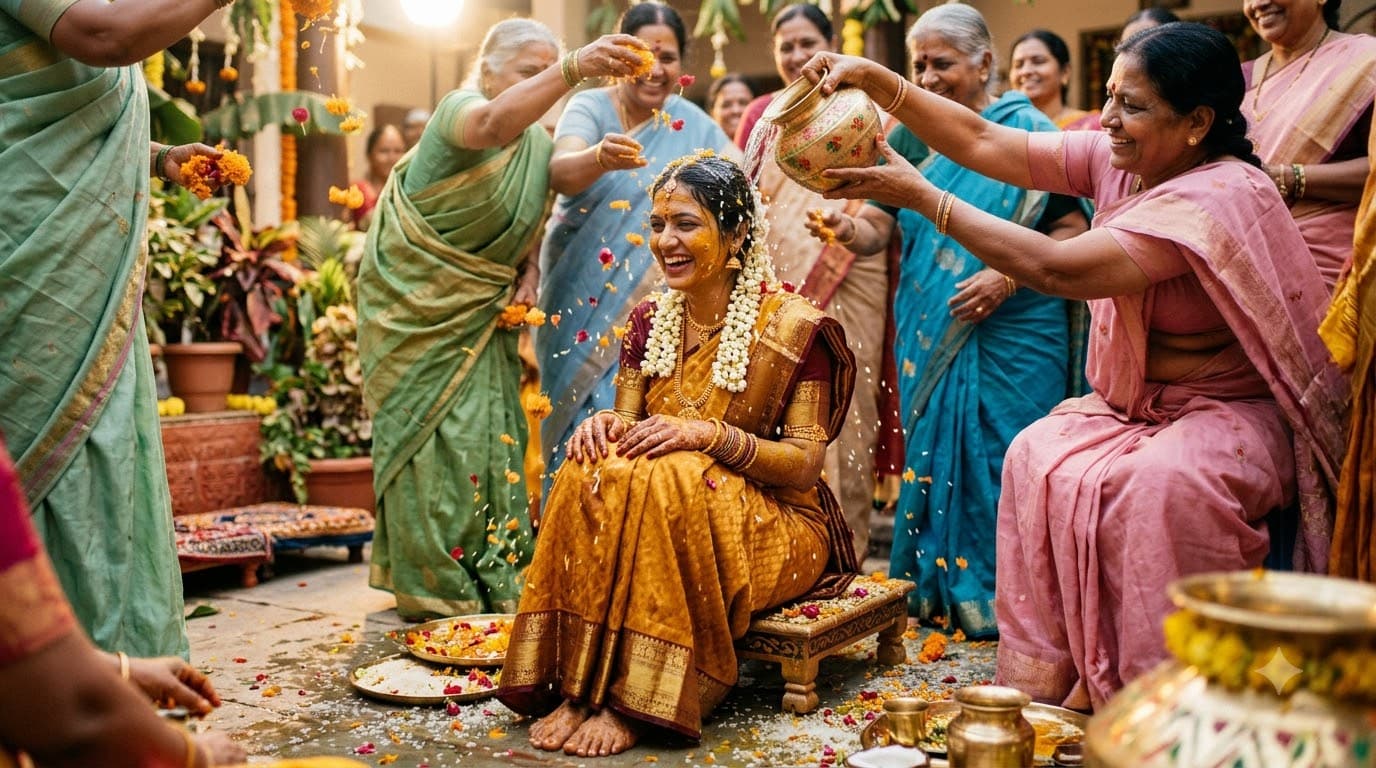 telugu-weddings
Pellikuthuru: 7 Sacred Rituals for a Beautiful Telugu Bride
Pellikuthuru is the sacred Telugu ritual where the bride is bathed in turmeric, anointed, and blessed by family before her wedding. Here’s the complete guide to its meaning, rituals, and planning.
Read article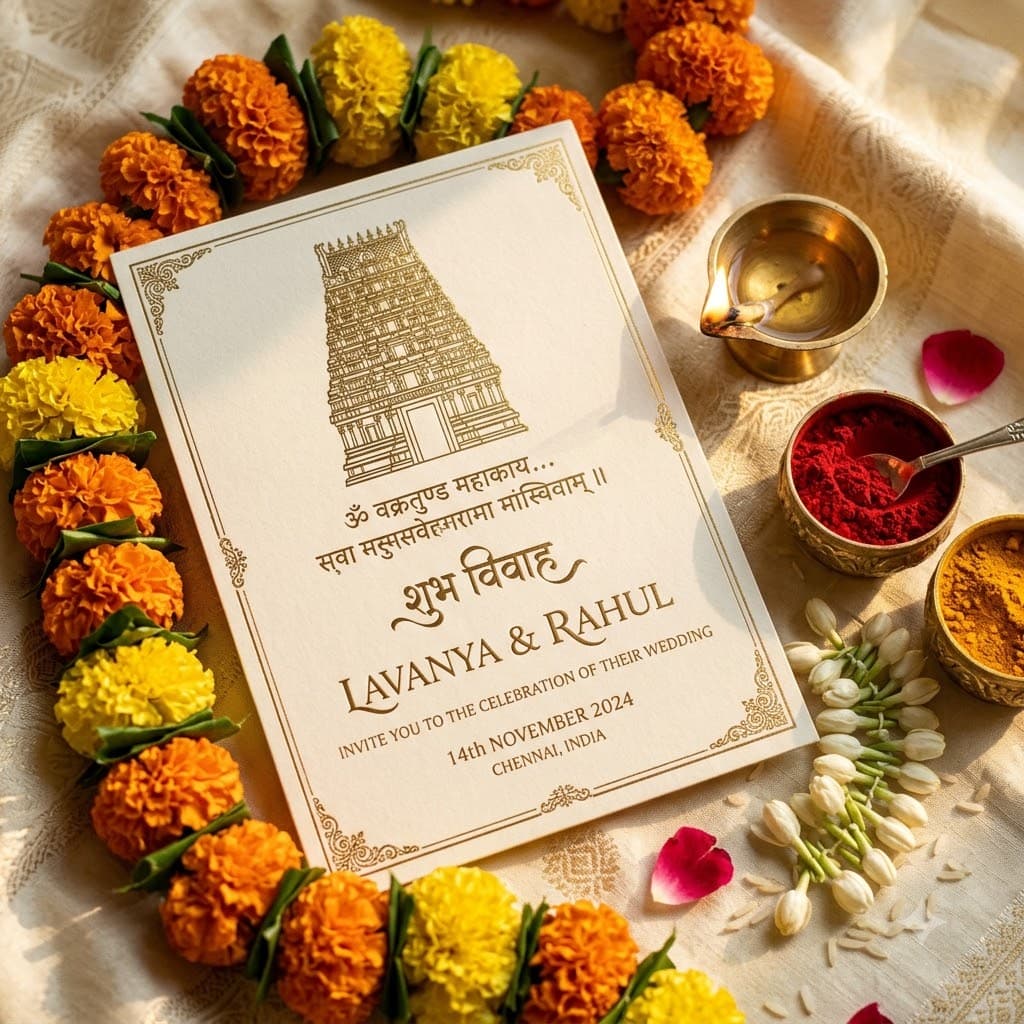 Invitation Ideas
Temple Wedding Invitation Wording: Best Guide (2026)
Key Takeaway: A temple wedding invitation is far more than a card announcing a date and venue. It is the […]
Read articleReady to create your wedding invitation?
Explore our handcrafted templates — designed for South Indian, Christian, and modern weddings. Share via WhatsApp in minutes.
Browse Templates