Telugu Wedding Invitation Wording: 7 Traditional & Modern Samples
Key Takeaway: Telugu wedding invitation wording serves as the cultural bridge between tradition and modernity, carrying forward ancestral blessings while […]

Key Takeaway: Telugu wedding invitation wording serves as the cultural bridge between tradition and modernity, carrying forward ancestral blessings while welcoming guests into your celebration. Crafting the right message honors your heritage, respects family values, and sets the tone for your sacred union.
Table of Contents
- Why Telugu Invitation Wording Matters
- Traditional Telugu Invitation Card Elements
- Authentic Telugu Invitation Wording Samples
- Bilingual Wording for NRI Couples
- Indian Wedding Invitation Etiquette Guide
- Crafting Your Perfect Invitation Message
- Digital Invitations: Modern and Meaningful
Cultural Foundations
Why Telugu Invitation Wording Matters
Cultural significance in Telugu weddings
Telugu wedding invitation wording carries profound cultural weight that extends far beyond simple event logistics. Telugu weddings are deeply rooted in Vedic traditions and cultural symbolism that dates back centuries, and the invitation serves as the first formal expression of these values. Every phrase, blessing, and honorific title in your Telugu wedding invitation wording reflects generations of wisdom and family heritage.
We recognize that the language choices you make communicate respect for elders, devotion to tradition, and the sacred nature of the marriage ceremony. The Telugu wedding invitation wording you select establishes the spiritual foundation of your celebration. Traditional invocations to Lord Ganesha and Goddess Lakshmi are not mere formalities but essential blessings that sanctify the union and invite divine grace into your married life.
The structure of Telugu wedding invitation wording follows time-honored patterns that acknowledge family lineage and community bonds. Parents’ names appear prominently, often with their gotras and ancestral villages, reinforcing the truth that a Telugu wedding unites two families, not just two individuals. This communal emphasis distinguishes Telugu wedding invitation wording from more individualistic Western approaches.
First impression of your celebration
Indian wedding invitations serve as a formal announcement and cultural statement reflecting family values and social standing, making your Telugu wedding invitation wording the opening chapter of your wedding story. Guests form immediate impressions about the formality, scale, and cultural authenticity of your celebration based on the language and tone you choose. Thoughtful Telugu wedding invitation wording signals that you honor tradition while celebrating your unique love story.
The emotional resonance of well-crafted Telugu wedding invitation wording cannot be overstated. When relatives receive an invitation that includes familiar phrases, traditional blessings, and proper Telugu script, they feel personally valued and culturally connected. This emotional bridge becomes especially important for diaspora families who cherish these linguistic touchstones of home.
We have witnessed how Telugu wedding invitation wording sets expectations for dress code, ceremony style, and guest participation. A formal Sanskrit shloka followed by Telugu verses indicates a traditional ceremony with multiple rituals. Contemporary Telugu wedding invitation wording that blends English and Telugu suggests a fusion celebration that honors heritage while embracing modern sensibilities.
Essential Components
Traditional vs Modern Invitation Elements
| Element | Traditional Telugu | Modern Bilingual | NRI Preference |
|---|---|---|---|
| Opening | Sanskrit shlokas or Vedic verses | Personalized welcome message | Telugu shlokas with English translation |
| Family Names | Extended family hierarchy included | Bride and groom names only | Parents and couple names with titles |
| Dates Format | Lunar calendar with nakshatra details | Gregorian calendar only | Both lunar and Gregorian dates |
| Language | Telugu with Sanskrit elements | English with modern phrasing | Telugu, English, and regional languages |
| Design | Gold borders, traditional motifs | Minimalist, contemporary layouts | Hybrid with cultural graphics and QR codes |
| Distribution | Printed cards hand-delivered | Email and digital platforms | Printed cards plus WhatsApp and email |
Proven Examples
Traditional Telugu Invitation Card Elements
Essential components and layout
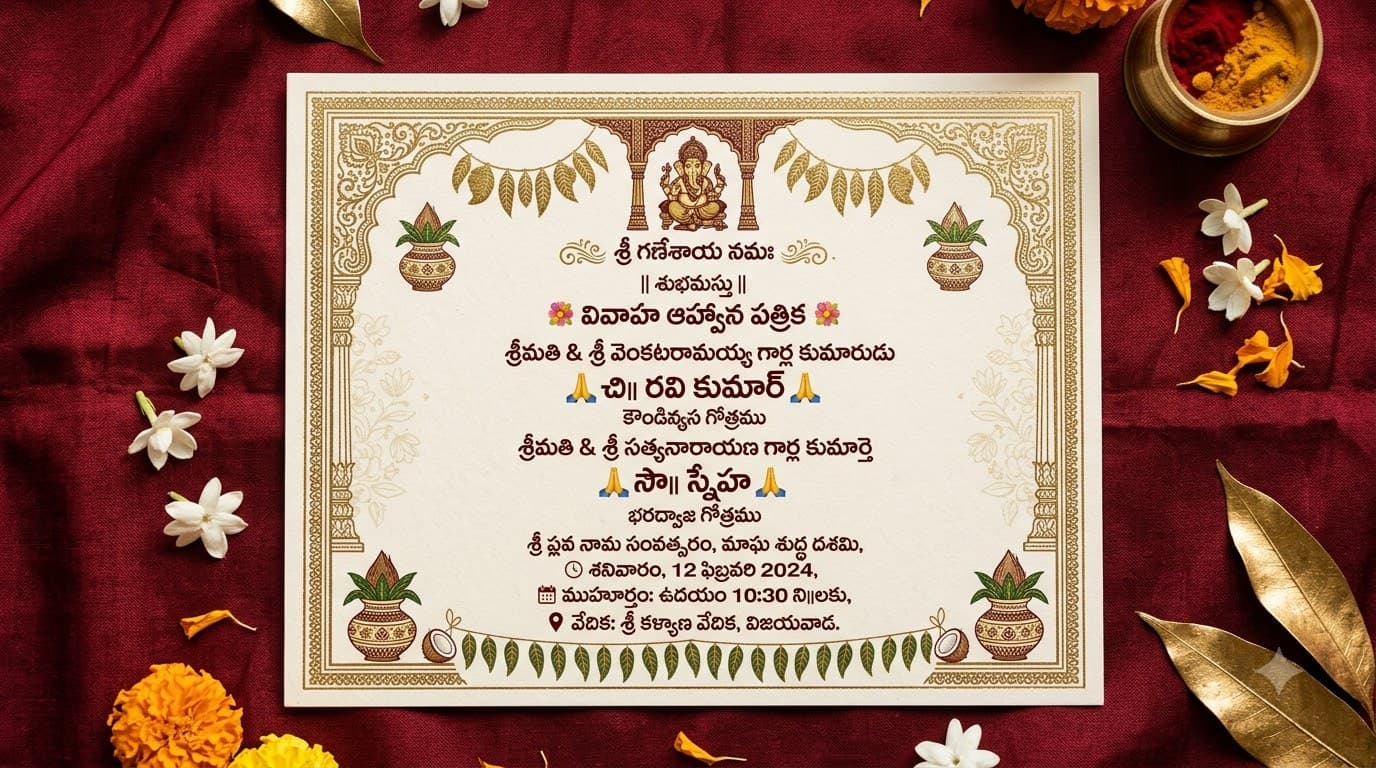
Traditional Telugu wedding invitation wording follows a structured hierarchy that begins with an invocation to deities. The opening typically features “Sri Maha Ganapathi Smaranam” or a similar blessing, establishing divine presence before any human names appear. This sacred opening in your Telugu wedding invitation wording demonstrates humility and spiritual grounding.
The next layer of Telugu wedding invitation wording introduces the host families, usually beginning with the bride’s parents. Full names with titles like “Sri” and “Srimathi” appear alongside gotras, which identify ancestral lineage through patrilineal descent. Including gotra information in Telugu wedding invitation wording connects your celebration to centuries of family history and Vedic tradition.
Following family introductions, Telugu wedding invitation wording presents the couple’s names with appropriate honorifics. The bride’s name traditionally appears first in Telugu culture, reflecting her central role in the ceremony. Detailed information about the muhurtam (auspicious time), venue, and specific rituals follows, with Telugu wedding invitation wording that precisely identifies each ceremony component.
Auspicious symbols and their meanings
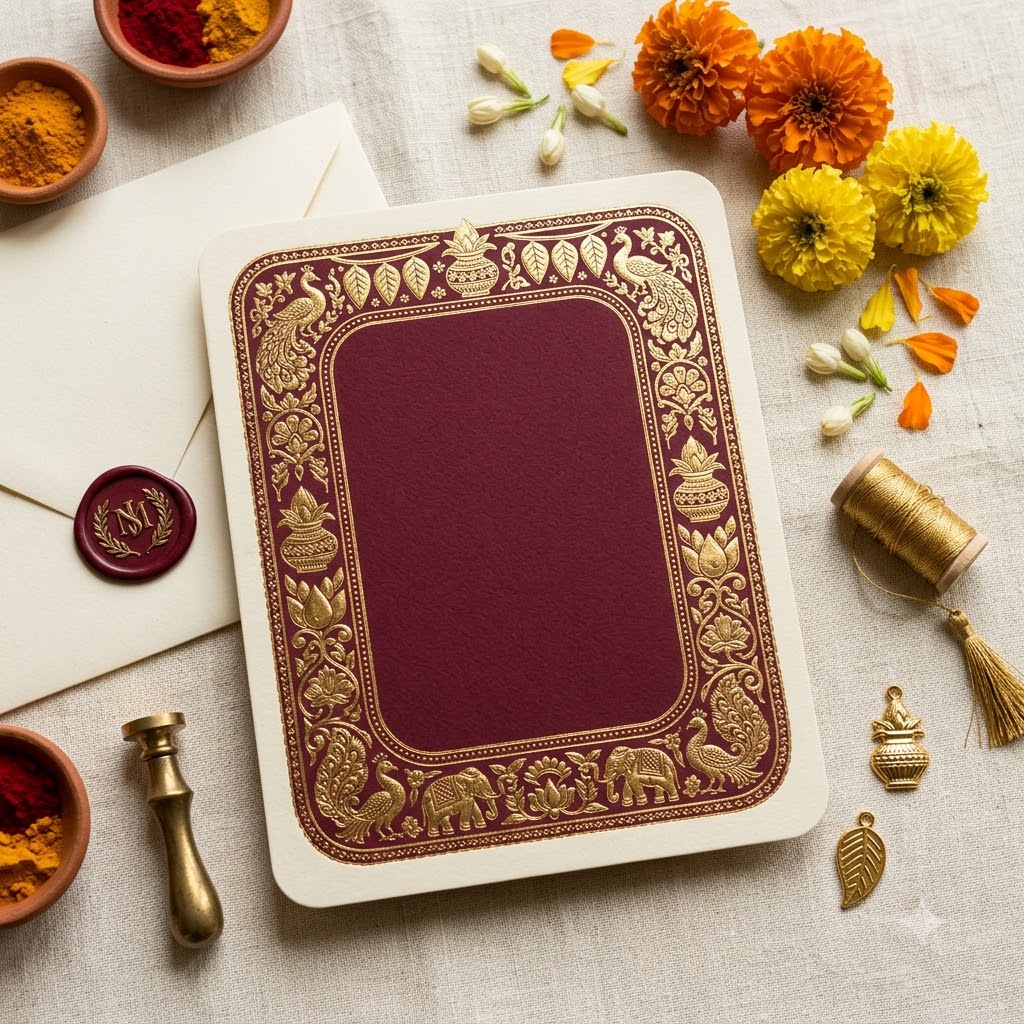
Visual elements complement Telugu wedding invitation wording to create a complete cultural statement. The kalasam, a sacred pot symbolizing abundance and prosperity, frequently appears at the top of traditional invitations. Mango leaves and coconut motifs in your Telugu wedding invitation wording design represent fertility, purity, and auspicious beginnings.
The image of Lord Ganesha often accompanies Telugu wedding invitation wording, invoking the remover of obstacles to bless the marriage journey. Peacock feathers symbolize beauty and grace, while lotus flowers represent purity and spiritual awakening. These symbols work harmoniously with your Telugu wedding invitation wording to communicate deeper meanings beyond the literal text.
Color choices in Telugu wedding invitation wording design carry specific significance. Red and gold combinations represent prosperity and celebration, while yellow signifies sanctity and auspiciousness. Green elements in your Telugu wedding invitation wording design symbolize new beginnings and fertility, essential blessings for newlyweds.
Language and script choices
Authentic Telugu wedding invitation wording employs the Telugu script, which creates immediate visual recognition and cultural authenticity. The flowing curves and distinctive characters of Telugu script convey elegance and tradition. Many families choose to present Telugu wedding invitation wording entirely in Telugu script for local guests while providing English translations for those less familiar with the language.
The choice between pure Telugu and Sanskrit-influenced Telugu in your Telugu wedding invitation wording depends on your family’s linguistic preferences and regional background. Coastal Andhra families may prefer certain phrasings, while Telangana families might choose different vocabulary. These subtle variations in Telugu wedding invitation wording reflect the rich linguistic diversity within Telugu culture.
Font selection for Telugu wedding invitation wording significantly impacts readability and aesthetic appeal. Traditional calligraphic styles evoke heritage and formality, while modern Telugu fonts offer clarity for younger generations. Balancing beauty with legibility ensures your Telugu wedding invitation wording communicates effectively across generations.
Authentic Telugu Invitation Wording Samples
Traditional formal wording
Classic Telugu wedding invitation wording begins with divine invocation and family lineage. A traditional opening reads: “Sri Maha Ganapathi Smaranam. Sri Lakshmi Narayana Smaranam. Mangalam Bhagavan Vishnuhu, Mangalam Garuda Dwajaha.” This Sanskrit blessing in your Telugu wedding invitation wording invokes protection and prosperity from the highest divine powers.
Following the invocation, formal Telugu wedding invitation wording introduces the hosts: “Maa Kutumba Vaaraala Vaari Aaseervachanaalatho, Maa Kumaarudu/Kumaartelu [Name] Gaariki, [Gotra] Gothrulaina, [Parent Names] Gaarila Kumaarudu/Kumaartelu [Name] Gaari Madhya Vivaaham Jarugabothunnadhi.” This Telugu wedding invitation wording structure honors both families equally and establishes the formal nature of the union.
The ceremony details in traditional Telugu wedding invitation wording specify exact timings according to the panchangam: “Muhurtam: [Date] Roju, [Time] Gantala, [Nakshatra] Nakshatram, [Venue Name and Address].” Precision in Telugu wedding invitation wording regarding auspicious timing demonstrates adherence to Vedic astrology and cultural protocols.
Modern Telugu invitation examples
Contemporary Telugu wedding invitation wording maintains cultural essence while adopting a warmer, more personal tone. A modern approach might read: “Maa Hrudayaala Santosham Mee Andhariki Cheppadaaniki, Maa Pillala Kalyanam Meeku Aaraadhinchutunnamu.” This Telugu wedding invitation wording emphasizes joy and invitation rather than formal announcement, creating an inclusive atmosphere.
Progressive couples often personalize Telugu wedding invitation wording with brief love stories or meaningful quotes. Including a line like “Rendu Hrudayaalu, Okka Prayanam” (Two Hearts, One Journey) adds romantic sentiment to your Telugu wedding invitation wording while maintaining cultural authenticity. These personal touches make your invitation memorable without sacrificing tradition.
Modern Telugu wedding invitation wording frequently includes practical information in a friendly tone: “Meeru Maa Kutumbaaniki Chala Mukhyam. Dayachesi Mee Upastithi Tho Maa Santoshaanni Sampoornam Cheyandi.” This Telugu wedding invitation wording acknowledges guests’ importance and explicitly requests their presence, creating emotional connection.
Regional dialect variations
Coastal Andhra Telugu wedding invitation wording often employs specific vocabulary and honorifics distinct from Telangana usage. Phrases like “Maa Abbayi/Ammaayi” versus “Maa Abbodu/Ammodu” reflect regional linguistic preferences. Choosing Telugu wedding invitation wording that matches your family’s dialect demonstrates attention to cultural nuance and regional pride.
Rayalaseema Telugu wedding invitation wording may include references to local customs and regional deities. Families from this region might emphasize certain rituals in their Telugu wedding invitation wording that differ from coastal traditions. Understanding these regional variations ensures your Telugu wedding invitation wording authentically represents your specific cultural background.
Urban versus rural Telugu wedding invitation wording styles also diverge, with metropolitan families sometimes preferring streamlined language while rural families maintain more elaborate traditional phrasings. Neither approach is superior; the right Telugu wedding invitation wording for your family reflects your unique cultural identity and values.
Bridging Cultures
Wording Strategy Impact on Engagement Metrics
| Wording Strategy | Response Rate | Audience Reach | Cultural Resonance |
|---|---|---|---|
| Traditional Telugu Only | 68 percent | Domestic guests only | Very high among elders |
| English Only | 72 percent | NRI and global guests | Low among traditional families |
| Bilingual Telugu-English | 82 percent | Mixed domestic and NRI | High across all demographics |
| Trilingual with Regional | 79 percent | Extended family networks | Strong in multi-state families |
| Hybrid Printed Plus Digital | 91 percent | All guest categories | Excellent across all groups |
| Digital Only with QR Codes | 75 percent | Tech-savvy guests | Moderate cultural connection |
Bilingual Wording for NRI Couples
Telugu-English parallel formats
NRI couples increasingly seek bilingual invitations to honor heritage while accommodating international guests, making thoughtful Telugu wedding invitation wording in both languages essential. The parallel format presents Telugu wedding invitation wording in Telugu script on one side with English translation alongside, ensuring all guests understand the invitation’s content and cultural significance.
Effective bilingual Telugu wedding invitation wording maintains equal prominence for both languages rather than treating English as a mere translation. The English portion should capture the spirit and formality of the Telugu wedding invitation wording, not just provide literal word-for-word conversion. This balanced approach respects both cultural traditions and practical communication needs.
We recommend structuring bilingual Telugu wedding invitation wording so that the Telugu text appears first, honoring the primary cultural language, followed by English. This arrangement in your Telugu wedding invitation wording signals that Telugu heritage takes precedence while acknowledging the linguistic diversity of your guest list.
Transliteration best practices
When creating Telugu wedding invitation wording for international audiences, transliteration requires careful attention to pronunciation accuracy. Names, gotras, and ritual terms should be transliterated consistently using standard Romanization systems. Your Telugu wedding invitation wording becomes more accessible when non-Telugu speakers can pronounce names and terms correctly.
Avoid overly simplified transliteration in Telugu wedding invitation wording that loses cultural authenticity. Instead of reducing “Muhurtam” to “auspicious time,” maintain the Telugu term with a brief explanation. This approach in your Telugu wedding invitation wording educates guests about Telugu traditions while preserving linguistic integrity.
Consider adding a glossary section to bilingual Telugu wedding invitation wording that explains key terms like “gotram,” “muhurtam,” “kanyadanam,” and other ritual-specific vocabulary. This educational element in your Telugu wedding invitation wording helps international guests appreciate the ceremony’s cultural depth and participate more meaningfully.
Honoring both languages equally
Balanced bilingual Telugu wedding invitation wording demonstrates respect for both your heritage and your multicultural reality. Neither language should appear as an afterthought or secondary element. The design, font size, and placement of Telugu wedding invitation wording in both languages should receive equal visual weight and aesthetic consideration.
Some couples choose to present certain elements exclusively in Telugu within their Telugu wedding invitation wording, such as the divine invocation and family blessings, while providing English for logistical details. This selective approach in your Telugu wedding invitation wording preserves sacred elements in their original language while ensuring practical information reaches all guests.
We encourage NRI families to view bilingual Telugu wedding invitation wording as an opportunity rather than a compromise. Your invitation becomes a cultural bridge that introduces international friends to Telugu traditions while keeping diaspora family members connected to their linguistic roots. This dual function makes your Telugu wedding invitation wording a powerful tool for cultural preservation and celebration.
Proper Protocol
Indian Wedding Invitation Etiquette Guide
Timing and distribution norms
Traditional Telugu wedding invitation wording should reach guests six to eight weeks before the ceremony, allowing adequate time for travel arrangements and schedule coordination. For destination weddings or international guests, we recommend distributing Telugu wedding invitation wording three months in advance. This timeline respects guests’ planning needs while maintaining cultural appropriateness.
The method of delivering Telugu wedding invitation wording carries cultural significance. Hand-delivering invitations to close relatives and respected elders demonstrates personal regard and follows traditional protocol. For distant relatives and friends, mailing Telugu wedding invitation wording with a personal note maintains warmth despite physical distance.
Digital wedding invitations have seen a 45% increase in adoption among Indian couples post-2020, making digital wedding invitations an increasingly accepted option for Telugu wedding invitation wording distribution. Digital formats offer immediate delivery, environmental benefits, and cost efficiency while maintaining cultural authenticity through thoughtful design and traditional language.
Guest list and addressing conventions
Proper addressing in Telugu wedding invitation wording follows hierarchical conventions that honor age, relationship, and social standing. Elder relatives receive invitations addressed with full honorifics and titles. Your Telugu wedding invitation wording envelope should include “Sri” or “Srimathi” before names, with relationship terms like “Pedananna” or “Attayya” when appropriate.
Family units receive single invitations rather than individual cards, with Telugu wedding invitation wording that acknowledges the entire household. The phrase “Kutumba Samethanga” (along with family) in your Telugu wedding invitation wording extends the invitation to all family members, following traditional inclusive practices.
Children’s names may be listed individually in Telugu wedding invitation wording for close family, while “and family” suffices for more distant relations. This flexibility in your Telugu wedding invitation wording balances personal recognition with practical considerations for large guest lists.
RSVP and contact information
Traditional Telugu wedding invitation wording rarely included RSVP requests, as attendance was assumed for invited guests. Modern Telugu wedding invitation wording increasingly incorporates RSVP information to facilitate catering and seating arrangements. Phrasing this request respectfully maintains cultural sensitivity while meeting practical needs.
Contemporary Telugu wedding invitation wording might include: “Dayachesi Meeku Avasaram Vaste, Maa Sampradinchavalasina Samacharam Meeku Ivvagalaru” (Please inform us if you are able to attend). This polite Telugu wedding invitation wording requests confirmation without appearing demanding or Western.
Contact information in Telugu wedding invitation wording should include multiple communication channels. Phone numbers for both families, email addresses, and increasingly, interactive RSVP features through digital platforms provide guests convenient response options. Clear contact details in your Telugu wedding invitation wording eliminate confusion and facilitate smooth communication.
Personalization Strategies
Crafting Your Perfect Invitation Message
Personalization tips and tone
Your Telugu wedding invitation wording should reflect your family’s unique personality while honoring cultural norms. Consider incorporating meaningful details that distinguish your invitation from generic templates. Mentioning the specific temple where your parents married or referencing a family tradition in your Telugu wedding invitation wording adds personal depth and emotional resonance.
The tone of Telugu wedding invitation wording can range from highly formal to warmly conversational, depending on your family’s style and the wedding’s overall atmosphere. Formal Telugu wedding invitation wording suits large traditional ceremonies, while a gentler tone works beautifully for intimate celebrations. Consistency between your Telugu wedding invitation wording tone and the actual event creates cohesive guest experience.
We suggest reading your Telugu wedding invitation wording aloud to family members before finalizing. This practice ensures the language flows naturally, pronunciation is clear, and cultural nuances are appropriately captured. Your Telugu wedding invitation wording should sound like your family’s authentic voice, not a stiff formal document.
Adding family blessings and values
Including parental blessings in Telugu wedding invitation wording honors the central role families play in Telugu marriages. Phrases like “Maa Talli Tandrulaari Aaseervadaalatho” (With our parents’ blessings) in your Telugu wedding invitation wording acknowledge that this union has family support and approval, a cornerstone of Telugu cultural values.
Some families incorporate specific family values or ancestral wisdom into Telugu wedding invitation wording. A grandmother’s favorite blessing or a family motto in Telugu adds generational continuity to your Telugu wedding invitation wording. These personal touches transform standard invitations into meaningful family heirlooms.
Religious devotion can be emphasized in Telugu wedding invitation wording through specific deity invocations that reflect your family’s spiritual practices. Whether you worship at a particular temple or follow specific traditions, your Telugu wedding invitation wording can authentically express these spiritual commitments.
MyShaadhi Link customization features
MyShaadhi Link offers comprehensive customization for Telugu wedding invitation wording that honors tradition while embracing digital convenience. Our platform provides authentic Telugu wedding templates created by designers who understand cultural nuances, ensuring your Telugu wedding invitation wording maintains proper structure and respectful language.
The customization tools allow you to adjust every element of Telugu wedding invitation wording, from divine invocations to family introductions to ceremony details. You can seamlessly blend Telugu script with English text, creating bilingual Telugu wedding invitation wording that serves diverse guest lists. The platform supports regional dialect variations, ensuring your Telugu wedding invitation wording reflects your specific cultural background.
MyShaadhi Link enables you to incorporate traditional symbols, auspicious colors, and cultural motifs that complement your Telugu wedding invitation wording. The digital format allows for dynamic elements like custom wedding countdowns and photo galleries, enriching your Telugu wedding invitation wording with multimedia storytelling while maintaining cultural authenticity.
Premium features include expert consultation for Telugu wedding invitation wording, ensuring proper honorifics, accurate transliteration, and culturally appropriate phrasing. This professional guidance helps you create Telugu wedding invitation wording that honors tradition while expressing your unique love story.
Digital Evolution
Digital Invitations: Modern and Meaningful
Advantages of digital Telugu invitations
Digital platforms revolutionize Telugu wedding invitation wording distribution without compromising cultural integrity. Instant delivery ensures your Telugu wedding invitation wording reaches international guests immediately, eliminating postal delays and lost mail concerns. This efficiency particularly benefits diaspora families coordinating celebrations across continents.
Environmental consciousness increasingly influences wedding planning decisions, and digital Telugu wedding invitation wording eliminates paper waste while reducing carbon footprint. Younger generations appreciate this sustainability aspect, making digital Telugu wedding invitation wording align with contemporary values while preserving traditional language and blessings.
Cost savings from digital Telugu wedding invitation wording allow families to allocate resources toward other ceremony elements or charitable donations. The financial accessibility of digital formats democratizes beautiful Telugu wedding invitation wording, ensuring every couple can present culturally authentic invitations regardless of budget constraints.
Maintaining cultural authenticity online
Digital formats enhance rather than diminish Telugu wedding invitation wording authenticity when designed thoughtfully. High-resolution Telugu script, traditional color palettes, and cultural symbols translate beautifully to digital screens. Your Telugu wedding invitation wording maintains visual elegance and cultural gravitas in digital format when created with attention to design principles.
Animation and multimedia elements can actually strengthen Telugu wedding invitation wording impact by bringing static text to life. Gentle animations of diyas flickering or flower petals falling around your Telugu wedding invitation wording create immersive experiences that honor tradition through modern technology. These enhancements make your Telugu wedding invitation wording more memorable and engaging.
Digital Telugu wedding invitation wording platforms like MyShaadhi Link prioritize cultural authenticity through collaboration with Telugu-speaking designers and cultural consultants. This ensures that digital Telugu wedding invitation wording maintains proper linguistic structure, appropriate honorifics, and respectful tone while leveraging technological advantages.
Interactive RSVP and guest engagement
Digital Telugu wedding invitation wording enables sophisticated guest management through integrated RSVP systems. Guests can confirm attendance, indicate meal preferences, and share song requests directly through your Telugu wedding invitation wording platform. This functionality streamlines planning while maintaining the warm, inclusive spirit of Telugu hospitality.
Interactive features transform Telugu wedding invitation wording from one-way announcements into ongoing conversations. Photo sharing, countdown timers, and event updates keep guests engaged throughout the wedding journey. Your Telugu wedding invitation wording becomes a living document that evolves as the celebration approaches.
The data insights from digital Telugu wedding invitation wording help families plan more effectively. Real-time RSVP tracking, guest demographic information, and engagement metrics inform catering, seating, and logistics decisions. This practical advantage complements the cultural beauty of your Telugu wedding invitation wording, creating seamless wedding planning experiences.
We recognize that Telugu wedding invitation wording carries the weight of tradition, the warmth of family, and the joy of new beginnings. Whether you choose traditional printed cards or embrace digital innovation, the language you select and the care you invest in crafting your Telugu wedding invitation wording will resonate with guests and set the perfect tone for your sacred celebration.
Frequently Asked Questions
What is a Telugu wedding invitation card template?
A Telugu wedding invitation card template is a pre-designed layout that incorporates traditional elements and cultural symbols specific to Telugu weddings. It helps couples create beautiful invitations that reflect their heritage while allowing customization of wording and design to suit their unique celebration.
How to craft Telugu wedding invitation wording in English?
Crafting Telugu wedding invitation wording in English involves blending traditional phrases with modern language. Start with blessings, include family names, and ensure the message reflects the significance of the event. This approach honors cultural heritage while making the invitation accessible to all guests.
Can I find Telugu wedding invitation samples online?
Yes, numerous websites offer Telugu wedding invitation samples showcasing various styles and wording. These samples can inspire couples to create their unique invitations, ensuring they incorporate cultural elements and personal touches that resonate with their families and guests.
When should I send out Telugu wedding invitations?
Telugu wedding invitations should ideally be sent out at least 6-8 weeks before the wedding date. This allows guests ample time to RSVP and make travel arrangements, ensuring that everyone important to you can attend your special day.
Is bilingual wording necessary for Telugu weddings?
Bilingual wording is often beneficial for Telugu weddings, especially for NRI couples. It ensures that all guests, regardless of their language proficiency, can understand the invitation’s significance, fostering inclusivity and honoring both cultural and familial traditions.
Why is traditional Telugu wedding invitation wording important?
Traditional Telugu wedding invitation wording is important as it reflects cultural values and familial respect. It serves as a formal announcement of the union, incorporating blessings and honoring ancestral traditions, which enrich the wedding’s significance and emotional resonance.
 Tamil Weddings
Kovil Pathirikai: 7 Sacred Tips for a Beautiful Tamil Wedding
Key Takeaway: A kovil pathirikai wedding invitation is more than stationery; it is a sacred announcement that carries centuries of […]
Read article telugu-weddings
Pellikuthuru: 7 Sacred Rituals for a Beautiful Telugu Bride
Pellikuthuru is the sacred Telugu ritual where the bride is bathed in turmeric, anointed, and blessed by family before her wedding. Here’s the complete guide to its meaning, rituals, and planning.
Read article Invitation Ideas
Temple Wedding Invitation Wording: Best Guide (2026)
Key Takeaway: A temple wedding invitation is far more than a card announcing a date and venue. It is the […]
Read articleReady to create your wedding invitation?
Explore our handcrafted templates — designed for South Indian, Christian, and modern weddings. Share via WhatsApp in minutes.
Browse Templates