Tamil Wedding Invitation Wording: 25+ Beautiful Ideas
Key Takeaway: A traditional Tamil wedding invitation — the Kalyana Pathirikai — opens with an invocation to Lord Ganesha, states […]

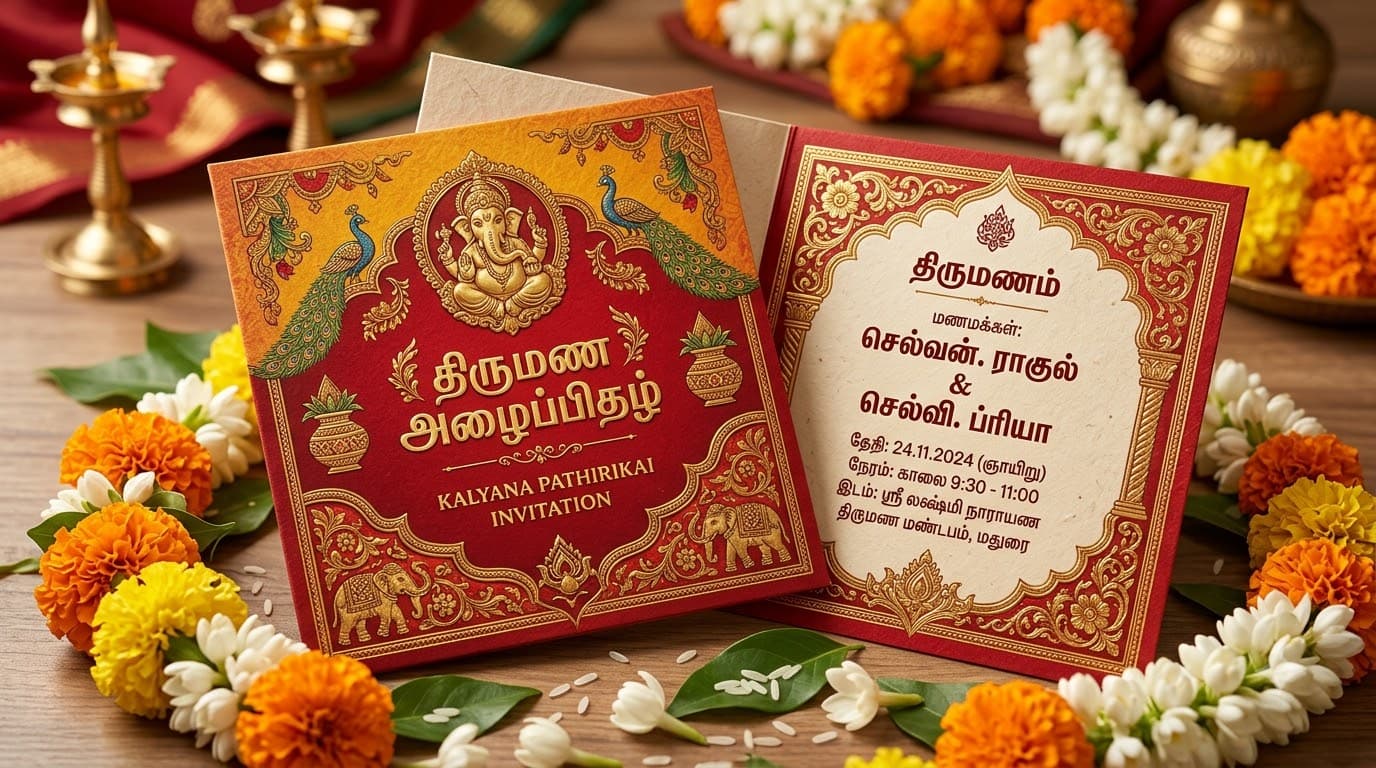
Key Takeaway: A traditional Tamil wedding invitation — the Kalyana Pathirikai — opens with an invocation to Lord Ganesha, states the auspicious muhurtham (wedding time) fixed by the family’s panchangam, and lists both families using formal Tamil honorifics like Thiru, Thirumathi, and Selvi. This guide gives you the exact structure, ready-to-use wording in Tamil and English, and etiquette for every event from Nichayathartham to the reception.
Table of Contents
- Why Tamil Wedding Invitation Wording Is Unique
- Essential Elements of a Tamil Wedding Invitation
- The Kalyana Pathirikai Format, Explained
- Traditional Wording Templates
- Wording for Every Event
- Bilingual and Modern Wording
- Digital Tamil Wedding Invitations
- Common Mistakes to Avoid
- Frequently Asked Questions
TAMIL WEDDING TRADITIONS
Why Tamil Wedding Invitation Wording Is Unique
Tamil wedding invitation wording carries more religious and astrological weight than a typical Western-style card. A Tamil wedding invitation, traditionally called a Kalyana Pathirikai (கல்யாண பத்திரிகை), isn’t just an announcement — it’s treated almost as a sacred document, opening with an invocation and stating the exact muhurtham (auspicious time) chosen by the family priest according to the panchangam, the traditional Hindu astrological calendar. Guests are expected to note this time carefully, since key rituals like the Kanyadanam or Mangalya Dharanam happen at that precise moment, not “sometime in the afternoon.”
This guide walks through the traditional structure, honorifics, and language conventions used in Tamil wedding invitation wording, along with modern and bilingual adaptations that keep the tradition intact while staying accessible to guests who don’t read Tamil — a common need for NRI and multi-city Tamil weddings planned through digital invitations.
THE BUILDING BLOCKS
Essential Elements of a Tamil Wedding Invitation
Most Tamil wedding invitation wording, whether printed or digital, is built from the same core components, arranged in a fairly fixed order.
| Element | Purpose | Example |
|---|---|---|
| Invocation | Opens the invitation with a blessing | “விநாயகர் துணை” (Vinayagar Thunai — with Lord Ganesha’s grace) |
| Family names | States who is hosting | “திரு. இராமன் & திருமதி. பார்வதி” |
| Couple’s names with honorifics | Identifies bride and groom respectfully | “சௌ. பிரியா” (bride) / “சி. கார்த்திக்” (groom) |
| Relationship line | Names the son/daughter and their parents | “puthirar” (son) / “puthiri” (daughter) |
| Muhurtham line | States the exact auspicious time | “சுப முகூர்த்தம் காலை 8.42 மணி” |
| Venue line | Gives the wedding hall or temple address | “திருமண மண்டபம், சென்னை” |
| Event schedule | Lists Nichayathartham, Kalyanam, Reception timings | Separate lines per event with date/time |
Modern and digital invitations often keep the invocation and muhurtham line — the two most non-negotiable elements — while simplifying or translating the rest for easier reading.
READING THE CARD
The Kalyana Pathirikai Format, Explained
If you’ve ever looked at a traditional Tamil wedding card and found the honorifics confusing, here’s what they mean.
Honorifics for parents
Thiru. (திரு.) is the Tamil equivalent of “Mr.,” and Thirumathi (திருமதி) is the equivalent of “Mrs.” These appear before the names of both sets of parents, who are listed as the hosts.
Honorifics for the bride and groom
The groom’s name is traditionally preceded by “Chi.” (சி.), short for Chiranjeevi, meaning “may he have a long life.” The bride’s name is preceded by “Sow.” (சௌ.), short for Sowbhagyavathi, meaning “one blessed with good fortune” — traditionally used once she is married, so some families use “Selvi” (செல்வி), the Tamil equivalent of “Ms.,” for the bride before the wedding and switch to “Sow.” only in post-wedding correspondence.
Relationship terms
The card states whose son or daughter each partner is, using “puthirar” (புத்திரர், son) or “puthiri” (புத்திரி, daughter), directly linking the couple’s names to their parents’ names for clarity — especially useful when multiple families share a surname or gotra.
| Term | Tamil Script | Used For | English Equivalent |
|---|---|---|---|
| Thiru. | திரு. | Father / male host | Mr. |
| Thirumathi | திருமதி | Mother / female host | Mrs. |
| Selvi | செல்வி | Bride (pre-wedding) | Ms. |
| Sow. (Sowbhagyavathi) | சௌ. | Bride (formal/married) | “Blessed with fortune” |
| Chi. (Chiranjeevi) | சி. | Groom | “Long-lived one” |
| Puthirar / Puthiri | புத்திரர் / புத்திரி | Son / daughter of | Son of / Daughter of |
Many modern families simplify this in English-language sections of the card, but keeping at least the Tamil honorifics on the traditional side is still considered respectful, particularly for the grandparents’ generation.
READY-TO-USE WORDING
Traditional Wording Templates
Traditional Tamil wedding invitation wording follows a fixed structure passed down for generations. The templates below show the full Tamil version alongside a natural English translation you can adapt.
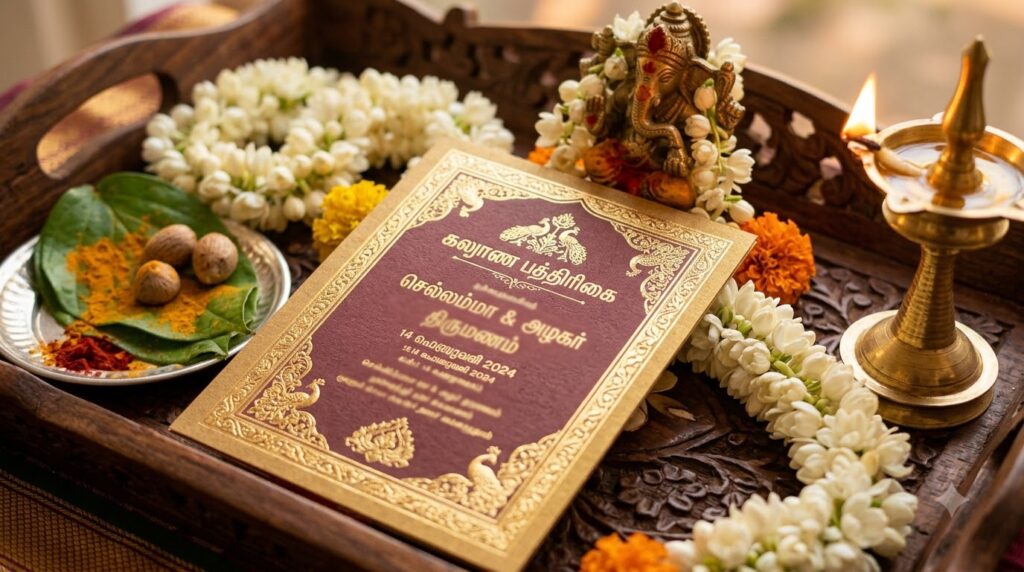
Classic Tamil Brahmin-style wording
ஸ்ரீ
விநாயகர் துணை
திரு. இராமன் & திருமதி. பார்வதி
அவர்களுடைய புத்திரி சௌ. பிரியா-வுக்கும்
திரு. கார்த்திகேயன் & திருமதி. மீனாக்ஷி
அவர்களுடைய புத்திரர் சி. கார்த்திக்-குக்கும்
நடைபெறவுள்ள திருமணத்திற்கு
தங்களை அன்புடன் அழைக்கிறோம்
சுப முகூர்த்தம்: காலை 8.42 மணி
சனிக்கிழமை, மார்ச் 14, 2026
திருமண மண்டபம், சென்னை
English translation of the same card
Sri
With the blessings of Lord Ganesha
Thiru. Raman & Thirumathi. Parvathi
request the pleasure of your company
at the wedding of their daughter Priya
with
Karthik
son of Thiru. Karthikeyan & Thirumathi. Meenakshi
Auspicious Muhurtham: 8:42 AM
Saturday, March 14, 2026
Kalyana Mandapam, Chennai
Notice that the muhurtham time is stated precisely, down to the minute — this is standard practice, since the time is calculated by a priest using the panchangam and is treated as fixed, not approximate.
FROM ENGAGEMENT TO RECEPTION
Wording for Every Event
Tamil weddings typically span several distinct events, each of which may get its own line — or its own card — in the invitation.
Nichayathartham (engagement)
Nichayathartham (Engagement Ceremony)
Friday, March 6, 2026 · 6:00 PM
Residence of the bride’s family, Chennai
Mangala Snanam and Kashi Yatra
Some families list the pre-wedding rituals like Mangala Snanam (the ceremonial bath) or, for the groom, the playful Kashi Yatra, especially when close relatives are expected to attend these smaller functions in person.
Kalyanam (the wedding)
Kalyanam
Muhurtham: 8:42 AM
Saturday, March 14, 2026
Kalyana Mandapam, Chennai
Reception to follow at 7:00 PM the same venue
Reception
When the reception is a separate event (common for destination or multi-city Tamil weddings), it gets its own clearly labeled line so out-of-town guests who can only attend one function know exactly which one to plan for.
| Event | Tamil Name | Typical Timing | Who Usually Attends |
|---|---|---|---|
| Engagement | Nichayathartham | Days to weeks before | Close family and friends |
| Ceremonial bath | Mangala Snanam | Morning of the wedding | Immediate family |
| Wedding rituals | Kalyanam | At the fixed muhurtham | All invited guests |
| Reception | Reception / Vratham | Same day evening, or separate day | Extended guest list |
TWO LANGUAGES, ONE INVITATION
Bilingual and Modern Wording
Most Tamil wedding invitation wording today is designed bilingually — Tamil on one side or in the traditional block, English on the other — so that grandparents and out-of-town or non-Tamil-reading guests can both read it comfortably.
Modern, warmer English wording
Together with their families
Priya & Karthik
invite you to celebrate their Kalyanam
Saturday, March 14, 2026 · Muhurtham at 8:42 AM
Kalyana Mandapam, Chennai
Reception to follow at 7:00 PM
Even in a casual, modern English version, most Tamil families still keep the muhurtham time and the word “Kalyanam” itself — these two details signal to Tamil guests exactly how formal and ritual-precise the ceremony will be, something a generic “wedding ceremony” doesn’t convey.
GOING DIGITAL
Digital Tamil Wedding Invitations
Digital Tamil wedding invitation wording needs to handle a few things print cards don’t: Tamil Unicode fonts rendering correctly across every guest’s phone, a clear countdown to the exact muhurtham time (helpful across time zones for NRI guests), and separate RSVP tracking per event when Nichayathartham, Kalyanam, and the reception are spread across different dates or cities.
Platforms like MyShaadhi Link let you build a bilingual Tamil-English invitation with the muhurtham countdown built in, a per-event RSVP so relatives flying in for just the Kalyanam can respond separately from local guests attending every function, and a shareable link that works over WhatsApp — the primary way most Tamil families circulate invitations today.
AVOID THESE SLIP-UPS
Common Mistakes to Avoid
Most Tamil wedding invitation wording mistakes come down to precision — getting the muhurtham time, the honorifics, or the event labels exactly right matters more here than in a typical wedding invitation.
- Rounding the muhurtham time: writing “morning” instead of “8:42 AM” defeats the purpose of an astrologically fixed time and can cause guests to miss the actual ritual
- Mixing up “Chi.” and “Sow.”: these honorifics are gender- and role-specific — swapping them is a visible error to anyone who reads Tamil
- Dropping the invocation: omitting “Vinayagar Thunai” or the Sri symbol at the top can read as an oversight to more traditional relatives, even on a modern card
- Unclear event separation: not labeling which line refers to Nichayathartham vs. Kalyanam vs. Reception confuses guests deciding which functions to attend
- Font rendering issues on digital cards: Tamil script can break or show as boxes on some devices if the invitation isn’t built with proper Unicode font support
Design Your Tamil Wedding Invitation with MyShaadhi Link
From the Vinayagar Thunai invocation to a muhurtham countdown your NRI relatives can follow in their own time zone, MyShaadhi Link helps you build a bilingual Tamil-English digital invitation that keeps every tradition intact — with per-event RSVP tracking for Nichayathartham, Kalyanam, and the reception.
COMMON QUESTIONS
Frequently Asked Questions
What does “Vinayagar Thunai” mean on a Tamil wedding invitation?
“Vinayagar Thunai” (விநாயகர் துணை) means “with the help/grace of Lord Ganesha.” It’s a traditional invocation placed at the very top of Tamil wedding invitations, and often other formal documents, to seek blessings before any auspicious undertaking.
Why is the muhurtham time so specific on Tamil wedding cards?
The muhurtham is calculated by a priest using the panchangam (Hindu astrological calendar) to identify the most auspicious moment for the marriage rituals. It’s stated to the exact minute because key rites like the Mangalya Dharanam are meant to happen precisely then, not at an approximate time.
What’s the difference between “Chi.” and “Sow.” before a name?
“Chi.” (short for Chiranjeevi) precedes the groom’s name and wishes him a long life. “Sow.” (short for Sowbhagyavathi) precedes the bride’s name and refers to her being blessed with marital good fortune. Some families use “Selvi” for the bride before the wedding and switch to “Sow.” afterward.
Should a Tamil wedding invitation be printed in Tamil, English, or both?
Most modern Tamil families print or design bilingual invitations, with the traditional Tamil wording for elders and relatives who read Tamil, and an English translation or a simplified modern English version for younger guests, colleagues, and non-Tamil-speaking friends.
Do all Tamil weddings include a separate Nichayathartham invitation?
Not always. Some families send one combined invitation listing both the Nichayathartham (engagement) and Kalyanam (wedding) dates, while others — especially for larger, multi-city weddings — send a separate, more intimate invitation for the engagement to close family and friends only.
How do digital Tamil wedding invitations handle time zones for NRI guests?
A well-built digital invitation converts the fixed muhurtham time into each guest’s local time zone automatically, so an NRI relative in the US or UK sees exactly when the ceremony happens for them, rather than having to calculate the time difference from Indian Standard Time themselves.
 Tamil Weddings
Kovil Pathirikai: 7 Sacred Tips for a Beautiful Tamil Wedding
Key Takeaway: A kovil pathirikai wedding invitation is more than stationery; it is a sacred announcement that carries centuries of […]
Read article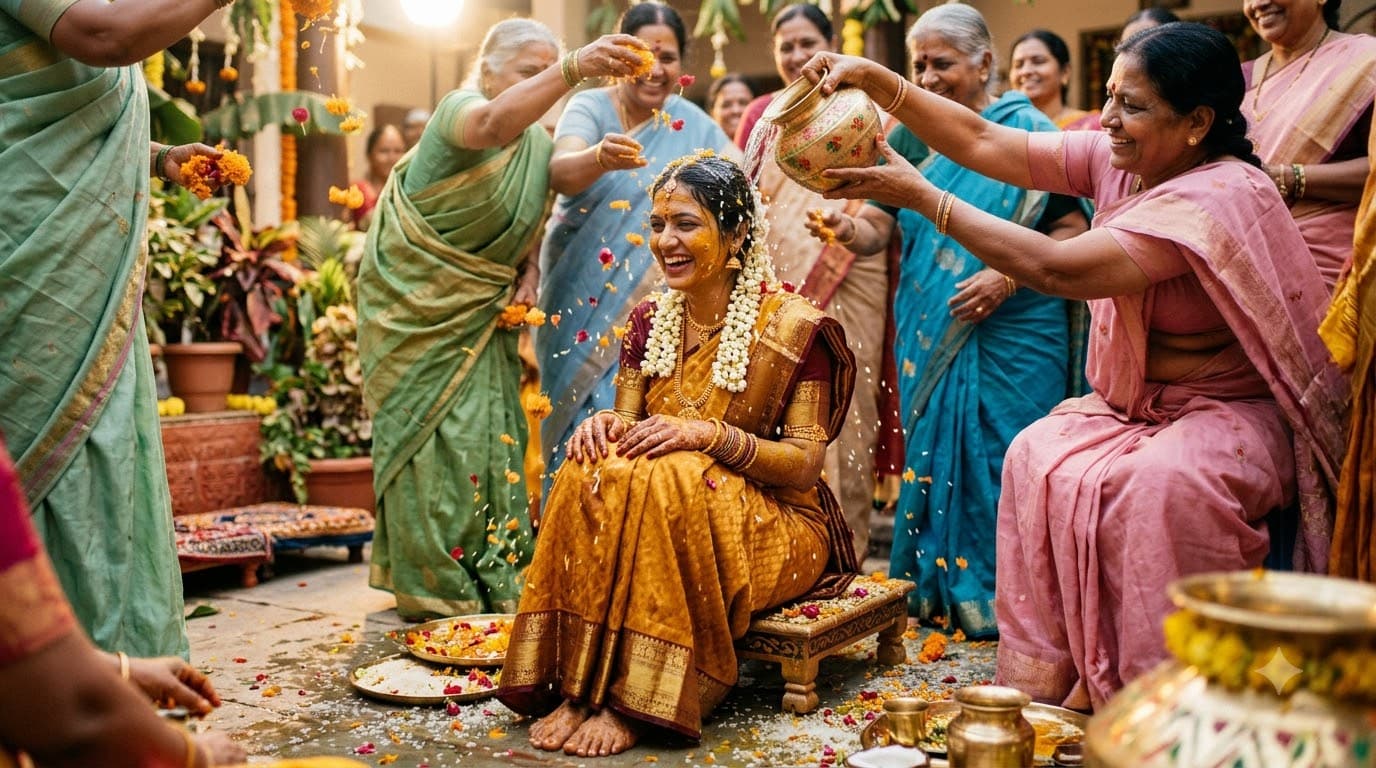 telugu-weddings
Pellikuthuru: 7 Sacred Rituals for a Beautiful Telugu Bride
Pellikuthuru is the sacred Telugu ritual where the bride is bathed in turmeric, anointed, and blessed by family before her wedding. Here’s the complete guide to its meaning, rituals, and planning.
Read article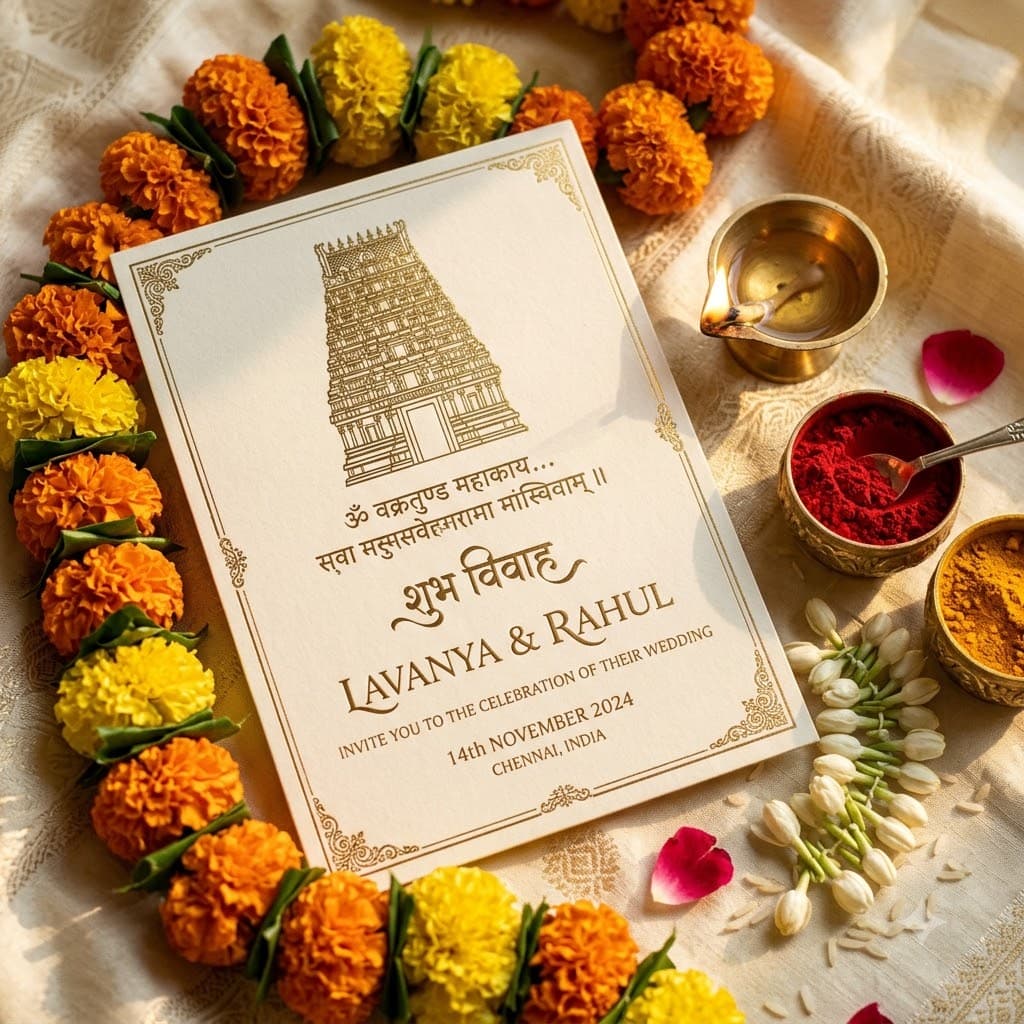 Invitation Ideas
Temple Wedding Invitation Wording: Best Guide (2026)
Key Takeaway: A temple wedding invitation is far more than a card announcing a date and venue. It is the […]
Read articleReady to create your wedding invitation?
Explore our handcrafted templates — designed for South Indian, Christian, and modern weddings. Share via WhatsApp in minutes.
Browse Templates